
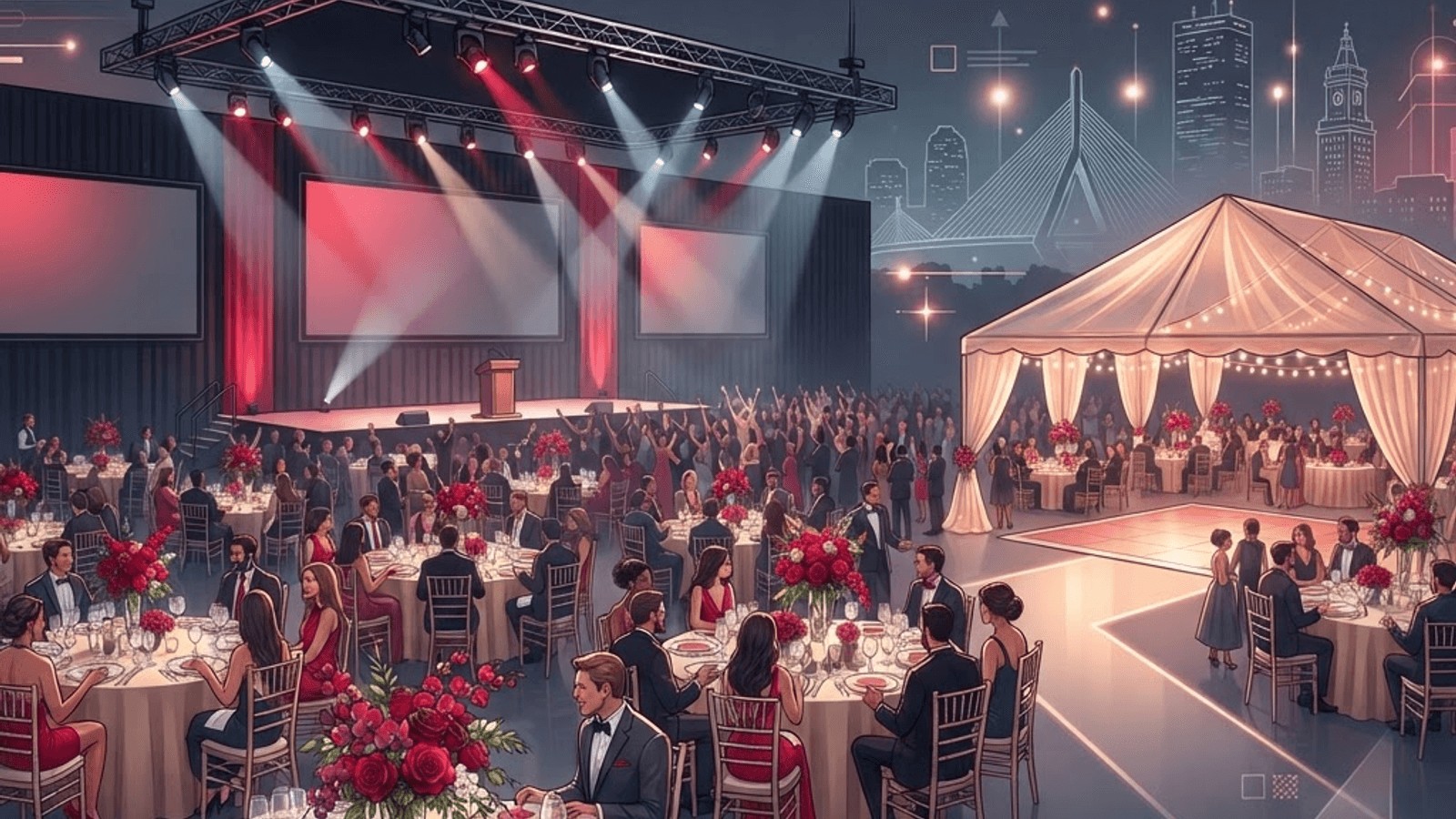
Why Boston Is a Demanding Events Market
Boston presents event planners with an unusual combination of opportunity and difficulty. On the opportunity side, the city offers extraordinary venues: historic halls, waterfront pavilions, university buildings, museums, converted industrial spaces in the Seaport and grand hotel ballrooms. It also draws a constant flow of academic conferences, biotech and medical congresses, financial industry gatherings, technology summits and major sporting and cultural events.
On the difficulty side, Boston is compact and old. Loading access is frequently constrained, permitting involves multiple municipal departments, historic venues have strict rules about rigging and decoration, union labour requirements apply at major facilities, and weather can disrupt outdoor plans in almost any season. Event management companies that thrive here do so because they know these constraints intimately and design around them from the outset.
Types of Event Companies
The market segments in useful ways. Full-service event management firms handle strategy, logistics, vendor management and on-site delivery end to end. Corporate and conference specialists focus on registration, content logistics, exhibitor management and attendee experience for large programmes. Wedding and social event planners manage highly personal celebrations with intensive client relationships. Production and technical companies deliver staging, lighting, audio, video and scenic elements. Destination management companies coordinate transport, activities and hospitality for visiting groups. Experiential marketing agencies build brand activations and product launches.
Many clients need a combination, most commonly a planner working alongside a separate production partner.
Top 10 Best Event Management Companies in Boston
1. Rafanelli Events. Perhaps the most internationally recognised name to emerge from Boston, this firm is renowned for exceptionally high-end galas, weddings and political and philanthropic events, distinguished by ambitious design and flawless execution.
2. Tenley Zumwalt Events and boutique social planners. Boston supports a strong cohort of boutique planners specialising in weddings and milestone celebrations, competing on personal attention, taste and deep venue relationships rather than scale.
3. Longwood Events. Operating several notable Boston-area venues alongside planning services, this type of venue-and-management operator simplifies delivery for clients who value a single accountable partner controlling both space and logistics.
4. Innovative Event Consultants. Representative of Boston's technical production sector, these firms provide staging, lighting, audiovisual and scenic design for corporate meetings, conferences and brand activations across the city's major venues.
5. Corporate Traveler and destination management companies serving Boston. DMCs coordinate incoming groups, arranging transport, venue sourcing, historic tours, harbour cruises and team programmes, and are essential for out-of-town organisers unfamiliar with local logistics.
6. Marathon Productions and conference management specialists. Firms focused on academic and medical conferences handle abstract management, speaker logistics, continuing education compliance and exhibitor operations, all of which are central to Boston's convention economy.
7. Eventions Productions. Full-service producers combining planning and technical delivery, suited to clients who want creative concept development and execution handled by one integrated team.
8. The Catered Affair. A prominent Boston catering and event company with strong venue partnerships, valued for culinary quality and the operational discipline required to serve large seated events in challenging historic spaces.
9. Marc Hall Design and experiential agencies. Design-led studios and experiential marketing agencies create branded environments, installations and immersive activations for product launches and consumer campaigns in the Seaport and Back Bay.
10. Nonprofit fundraising event specialists. Given Boston's dense nonprofit sector, several firms focus specifically on galas and benefit auctions, bringing expertise in revenue maximisation, donor experience and auction technology that generalist planners often lack.
How to Brief and Select a Partner
Start with objectives rather than logistics. A planner who understands whether you are trying to raise money, launch a product, educate an audience or celebrate a milestone will make better decisions on every subsequent detail. Provide a realistic budget range early; withholding it wastes everyone's time and produces proposals that cannot be delivered.
Evaluate proposals on relevant experience with your event type and size, the specific team members who will actually work on your event, vendor relationships in Boston, contingency planning depth and transparency of pricing. Ask directly how they handle failure, whether a keynote speaker missing a flight or a sudden venue problem, because response quality under pressure is what you are really buying.
Clarify the commercial model. Some firms charge a flat management fee, others a percentage of spend, others build margin into vendor pricing. None is inherently wrong, but you should understand which applies and how conflicts of interest are managed.
Trends in the Boston Events Sector
Hybrid and streamed components are now standard rather than exceptional for corporate and academic events, requiring production partners with genuine broadcast capability. Sustainability requirements have tightened considerably, with clients requesting waste diversion, local sourcing, reduced printed materials and measurable emissions reporting.
Attendee experience design has become more sophisticated, with planners applying behavioural insight to networking formats, session pacing and food service to improve engagement. Data has also become central, with registration platforms, engagement tracking and post-event analytics used to demonstrate return on investment.
Practical Advice
Book early, particularly for autumn and late spring, which are extremely competitive in Boston because of academic and conference calendars. Confirm venue restrictions and union requirements before finalising creative concepts. Build a genuine contingency reserve of at least ten percent. Finally, treat your event partner as a collaborator with useful expertise rather than a vendor executing instructions, which consistently produces better events.
