
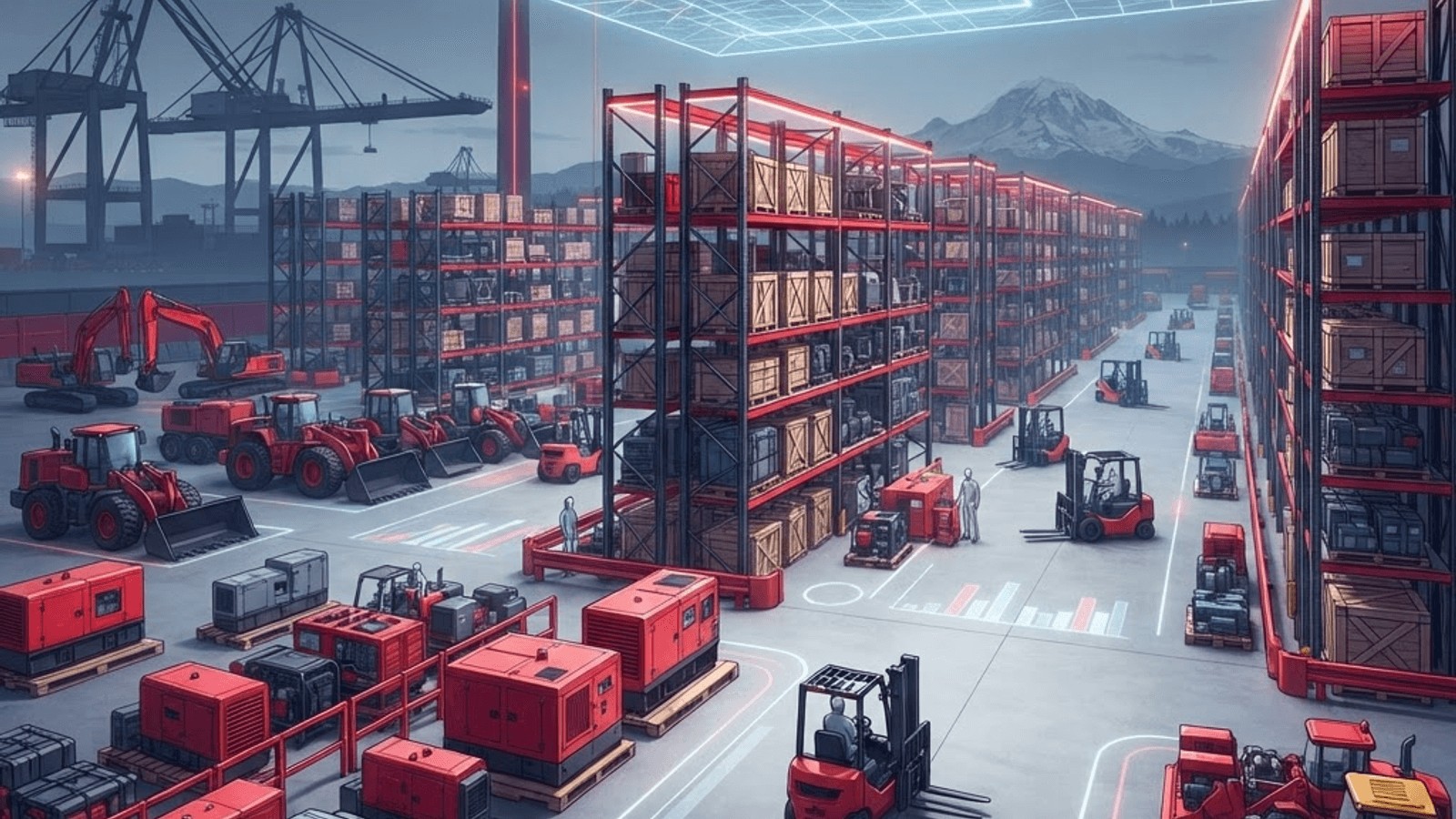
Why Equipment Distribution Is Strategic in Washington
Washington's economy is built on industries that run on machinery. Aerospace manufacturing demands precision tooling, compressed air systems and metrology equipment. Commercial construction across the Puget Sound corridor consumes excavators, lifts, compaction equipment and concrete tooling at scale. Food and beverage processing in the Yakima Valley and Columbia Basin requires conveyors, sanitary pumps, refrigeration and packaging lines. Marine and fishing operations need deck machinery, hydraulics and cold-chain systems. Warehousing and logistics around the ports rely heavily on material handling fleets.
Because so much of this activity is capital-intensive and downtime-sensitive, equipment wholesalers in the state function less like product vendors and more like uptime partners. The purchase transaction is often the smallest part of the relationship compared with parts supply, field service, operator training and eventual trade-in or resale.
Evaluating an Equipment Wholesaler
The single most important question is what happens after the machine arrives. Parts availability determines whether a breakdown costs hours or weeks, so buyers should ask about local parts inventory depth, access to manufacturer stock and typical fulfillment times for common wear items. Field service capacity matters just as much: how many technicians, how they are dispatched, guaranteed response windows and whether service trucks are equipped to complete repairs on site.
Beyond service, look at fleet flexibility. Rental, rent-to-own and used inventory allow companies to match equipment to fluctuating project loads without over-committing capital. Financing and leasing options, including options structured around seasonal cash flow, are meaningful for agricultural and construction customers. Compliance support is another differentiator, covering emissions tier requirements, Washington workplace safety regulations, operator certification for lifts and forklifts, and required inspection documentation. Finally, application engineering separates the best distributors, because specifying the wrong capacity or configuration is far more expensive than paying slightly more for the right one.
Ten Leading Equipment Wholesalers Serving Washington
1. Cascade Construction Equipment
A full-line construction distributor handling excavators, loaders, compaction equipment and attachments, supported by a substantial parts warehouse and mobile service fleet. Contractors value its guaranteed response commitments and the ability to swap machines mid-project when scope changes.
2. Puget Sound Industrial Supply
Focused on plant maintenance and production equipment including pumps, compressors, motors, gearboxes and hydraulic systems. Engineering support for system sizing and energy efficiency audits helps manufacturers reduce operating costs rather than simply replace failed units.
3. Rainier Material Handling
Specialized in forklifts, reach trucks, pallet jacks, conveyors and racking for distribution centers around the ports. Fleet management programs, telematics-based utilization reporting and OSHA-aligned operator certification training make it a strong fit for high-throughput warehouses.
4. Northwest Agricultural Machinery Supply
Serving orchards, vineyards and row-crop operations in central and eastern Washington with tractors, sprayers, harvest aids and irrigation equipment. Seasonal readiness programs and pre-harvest inspection services address the reality that a failure during a two-week harvest window can be catastrophic.
5. Emerald City Restaurant Equipment
A commercial foodservice distributor supplying ranges, refrigeration, dishwashing systems, ventilation hoods and prep equipment. Kitchen layout design, health-code-aware specification and refrigeration service response are the pillars of its reputation among restaurateurs and institutional kitchens.
6. Olympic Marine and Deck Equipment
Concentrated on commercial fishing and workboat operations with winches, hydraulic power units, refrigeration, pumps and deck hardware built for saltwater service. Dockside service and rapid parts turnaround during fishing seasons define its value proposition.
7. Spokane Power Systems and Generators
Specializing in standby and prime power generation, transfer switches, and industrial electrical equipment for hospitals, data facilities and rural operations. Load-bank testing, preventive maintenance contracts and emergency response capability are central to its offering.
8. Salish Aerospace Tooling Partners
Supplying precision tooling, metrology instruments, tool control systems and compressed air infrastructure to aerospace and advanced manufacturing suppliers. Calibration services and traceable documentation support the strict quality systems these customers must maintain.
9. Evergreen Aerial Lift and Rental
A distributor and rental provider for scissor lifts, boom lifts, telehandlers and scaffolding with inspection, certification and operator training built into the program. Mixed rent-and-buy structures help contractors flex capacity across seasonal workloads.
10. Tacoma Used Equipment Exchange
Focused on inspected, reconditioned used machinery with documented service history and limited warranties, plus appraisal and remarketing services. For growing companies and those replacing aging fleets, it provides a disciplined way to acquire capability at lower capital cost.
Trends in the Equipment Market
Electrification is advancing quickly in compact construction and material handling equipment, driven by emissions rules, indoor air quality requirements and quieter operation for urban jobsites with noise restrictions. Telematics has moved from optional to expected, giving owners real-time utilization, fault codes and maintenance scheduling data that reduces unplanned downtime. Automation is spreading in warehousing and food processing, raising demand for distributors who can integrate systems rather than sell standalone machines. Parts supply chains remain a strategic concern, so many wholesalers have increased local stocking of critical components. And service-based models such as equipment-as-a-service and full-maintenance contracts continue to gain traction with companies prioritizing predictable operating expense over ownership.
Practical Buying Guidance
Build your evaluation around total cost of ownership rather than purchase price. Request documented parts fill rates and average service response times, and ask for references from customers with similar duty cycles. Confirm technician headcount and geographic coverage relative to your sites. Clarify warranty scope, including travel and labor. Consider rental for uncertain workloads and used equipment for secondary needs. Insist on operator training as part of the deal, since improper operation causes a large share of premature failures. Finally, review the resale and trade-in pathway before you buy, because exit value is part of the economics.
Final Thoughts
Equipment wholesaling in Washington is a service business wearing a product catalog. The distributors profiled here succeed because they keep parts close, field capable technicians, understand the regulatory environment and help customers specify correctly the first time. Whether you manage a construction fleet, a food processing line, a warehouse operation, an orchard or a commercial kitchen, aligning with a wholesaler whose service infrastructure matches your uptime requirements will deliver far more value than chasing the lowest invoice.
