
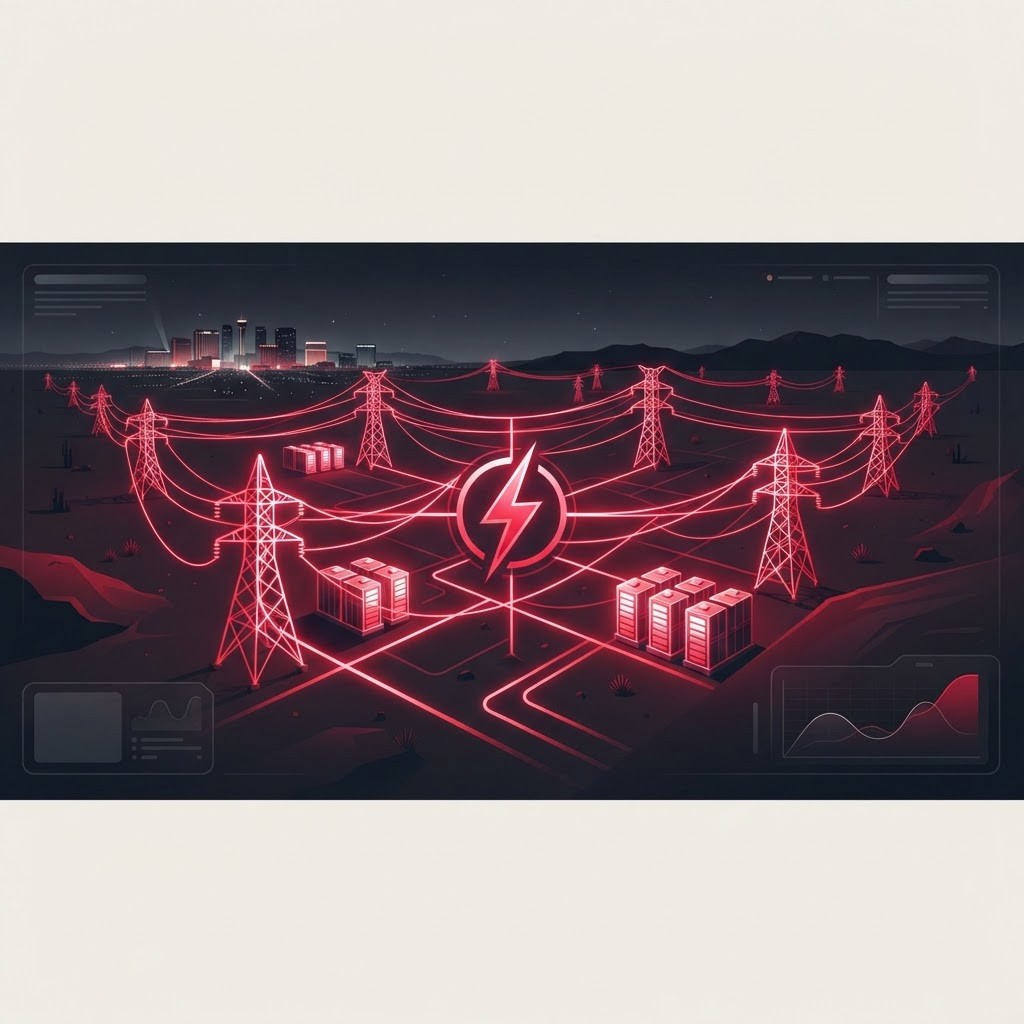
How Energy Supply Works in Las Vegas
Energy supply in Southern Nevada is more nuanced than in fully regulated markets. Most residential customers receive both delivery and generation service from the regional electric utility. Large commercial and industrial customers, however, have pathways to procure electricity from alternative providers under Nevada's regulatory framework, and several major resort operators and industrial users have pursued that option. Layered on top are natural gas distribution, propane supply for areas outside gas service, and a growing category of on-site generation and storage partners that reduce grid purchases altogether.
Understanding which category a supplier belongs to is essential. A utility delivers power through wires it owns and maintains. A competitive retail provider sells the energy commodity while delivery remains with the utility. An on-site generation partner installs equipment that produces power at your building. A demand management provider reduces what you buy without changing who supplies it. Each addresses a different part of the bill.
The Top 10 Energy Suppliers in Las Vegas
1. NV Energy. The dominant electric utility for Southern Nevada, responsible for transmission, distribution, and generation service for the vast majority of homes and businesses. It also administers renewable programs, efficiency rebates, and large customer rate options, making it the reference point for any energy decision in the Valley.
2. Southwest Gas. The natural gas distribution utility serving Las Vegas, Henderson, and North Las Vegas. It handles service connections, infrastructure safety, appliance rebate programs, and commercial gas service for the region's extensive restaurant and hospitality sector.
3. Tenaska Nevada Partners. A wholesale energy and asset management provider that supplies large commercial and industrial customers who have transitioned to alternative energy procurement, offering structured supply and risk management services.
4. Shell Energy North America. Provides competitive electricity and natural gas supply to large Nevada customers, including structured products, hedging, and renewable attribute procurement for organizations with sustainability targets.
5. Constellation Energy. A major competitive supplier serving large commercial accounts with electricity, natural gas, and renewable supply products, along with efficiency and generation services for multi-site operators.
6. Ormat Technologies. Nevada based and globally recognized, Ormat supplies renewable geothermal generation and operates battery storage assets, giving utilities and offtakers access to continuous clean energy rather than intermittent output alone.
7. Amerigas Las Vegas. The leading propane supplier for properties outside natural gas service territory, including residential communities on the Valley's edges, restaurants requiring patio heating, and industrial applications.
8. Bombard Renewable Energy. Functions as an on-site energy supply partner by designing and installing commercial solar, carport, and microgrid systems that reduce grid purchases for casinos, schools, and public facilities.
9. Sol-Up. A prominent Las Vegas solar company effectively serving as a distributed energy supplier for homeowners and small businesses, delivering long-term generation through owned rooftop systems and battery storage.
10. Desert Grid Energy Solutions. Provides demand management, load curtailment, and energy monitoring services that lower peak charges, an especially valuable offering given how heavily Las Vegas bills are driven by summer demand.
Reading Your Energy Bill Properly
Commercial energy bills in Las Vegas typically combine several components: energy charges for kilowatt hours consumed, demand charges based on the highest fifteen or thirty minute usage interval in the billing period, delivery and infrastructure charges, and various riders. Demand charges surprise many operators because a single brief spike can elevate costs for the entire month. Understanding this structure is essential, because the cheapest supplier rate cannot fix a load profile problem. Often the largest savings come from shifting or smoothing consumption rather than renegotiating the commodity price.
Strategies for Reducing Energy Costs
Start with metering and interval data analysis to see exactly when and why consumption peaks. Address cooling efficiency first, since HVAC dominates Las Vegas building load, through economizers, variable frequency drives, controls tuning, and roof insulation. Add lighting and refrigeration upgrades where applicable. Consider on-site solar to offset daytime consumption and battery storage to shave demand peaks. Explore utility efficiency incentive programs, which frequently offset a meaningful share of retrofit cost. Only then evaluate commodity procurement alternatives, where structured contracts can provide budget certainty.
Trends in the Nevada Energy Market
Data center development is adding substantial new load to Southern Nevada, driving transmission investment and clean energy procurement. Battery storage is scaling rapidly, changing how peak demand is served. Large customers increasingly want hourly matched clean energy rather than annual offsets, which favors suppliers with geothermal and storage capability. Building electrification is gradually shifting some load from natural gas to electricity, altering long-term planning for both utilities. Finally, extreme heat is elevating reliability and resilience to the top of many organizations' energy priorities.
How to Evaluate a Supplier
Clarify exactly what is being sold: commodity supply, delivery service, on-site generation, or demand reduction. Request pricing in a comparable format, ideally cost per kilowatt hour delivered plus any fixed charges. Understand contract term, termination provisions, and how usage variance is handled. Ask for references from similar Las Vegas facilities and, for generation projects, request measured production data. Confirm who is responsible for maintenance and performance guarantees over the contract life.
Final Thoughts
Las Vegas energy decisions carry real financial weight because cooling a desert city is expensive. The suppliers above span regulated utilities, competitive wholesale providers, renewable generators, propane distributors, and on-site energy partners. The most effective approach is usually layered: reduce consumption, generate on-site where feasible, manage demand peaks, and then optimize the remaining purchased supply. Approached that way, energy becomes a managed cost rather than an unpredictable one.
