
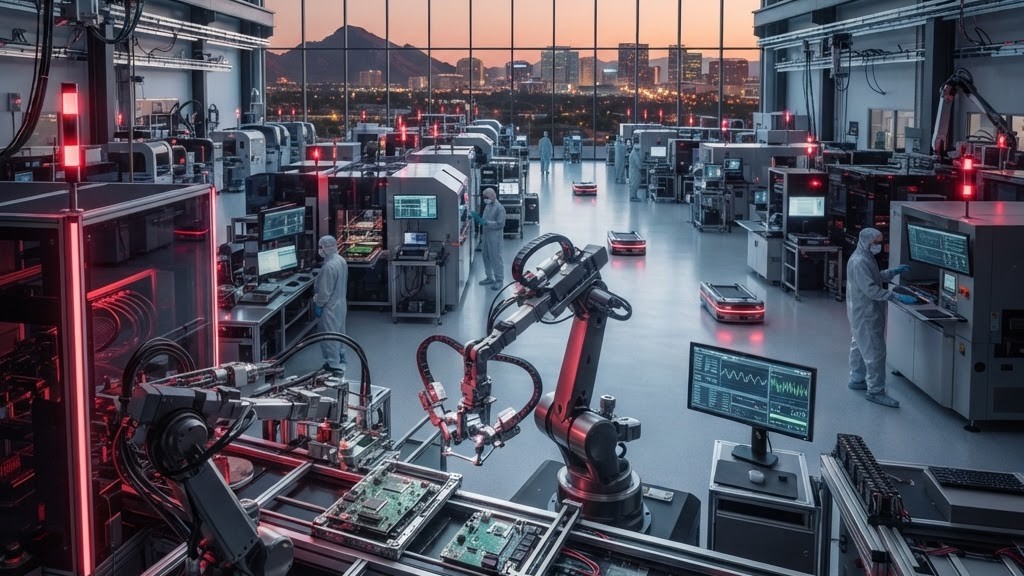
Why Phoenix Is an Electronics Manufacturing Hub
Greater Phoenix has developed one of North America's most important electronics clusters. The region combines a long semiconductor history, aerospace and defense demand, engineering universities, available industrial land, and a business environment shaped around advanced manufacturing. Recent fabrication investments have strengthened an already broad supply chain of chipmakers, equipment providers, electronic component companies, and contract manufacturers. Because these businesses serve different markets, the best choice depends on whether a buyer needs semiconductors, avionics, sensors, assemblies, or production support.
1. Intel
Intel's Chandler campus is a cornerstone of Arizona's semiconductor industry. The company has operated in the state for decades and continues to invest in advanced fabrication capacity. Its operations contribute high-value manufacturing, engineering talent, supplier demand, and workforce development to the Phoenix economy. Intel's scale and process sophistication make it central to discussions about domestic chip resilience and next-generation manufacturing, even though its direct customers are generally large technology businesses rather than local retail buyers.
2. TSMC Arizona
Taiwan Semiconductor Manufacturing Company's Arizona operations represent a transformational expansion of leading-edge chip production in the United States. The north Phoenix fabrication complex has attracted global attention and a growing network of suppliers. Its foundry model manufactures chips designed by other companies, making process technology, yield, reliability, and confidentiality essential differentiators. The investment is also accelerating demand for technicians, engineers, construction specialists, clean-room services, and semiconductor materials.
3. Microchip Technology
Chandler-headquartered Microchip Technology supplies microcontrollers, analog devices, connectivity products, and embedded control solutions used across automotive, industrial, aerospace, communications, and consumer applications. Its broad portfolio helps engineers design stable systems with long product lifecycles. The company is notable for combining semiconductor products with development tools and technical support. That ecosystem can reduce design complexity for manufacturers building connected or intelligent equipment.
4. onsemi
Phoenix-headquartered onsemi focuses on intelligent power and sensing technologies. Its products support electric vehicles, charging systems, renewable energy, factory automation, and advanced driver assistance. These are high-growth markets in which energy efficiency and reliable sensing have direct performance benefits. The company's local corporate and technical presence reinforces Phoenix's role not only as a production center but also as a base for semiconductor strategy and engineering.
5. NXP Semiconductors
NXP has significant operations in Chandler and a long Arizona legacy through predecessor semiconductor businesses. Its technologies span automotive processing, secure connectivity, industrial systems, identification, and edge computing. NXP is especially relevant to companies developing connected vehicles, smart infrastructure, and secure embedded products. Buyers value suppliers that can provide long-term roadmaps, functional safety support, and robust security features alongside component performance.
6. Honeywell Aerospace
Honeywell Aerospace has a major Phoenix presence and produces sophisticated avionics, engines, controls, and electronic systems. Aerospace electronics must perform under demanding temperature, vibration, reliability, and certification requirements. Honeywell's systems integration experience and established support network are key differentiators. Its operations also sustain a deep regional base of precision suppliers and specialized engineering talent.
7. Northrop Grumman
Northrop Grumman's Arizona activities include advanced aerospace and defense technologies that depend heavily on electronic controls, communications, guidance, and mission systems. Defense manufacturing emphasizes traceability, cybersecurity, configuration management, and exacting quality. Companies seeking to participate in this supply chain must be ready for rigorous documentation and compliance expectations. The presence of major defense contractors strengthens the Valley's market for high-reliability electronics.
8. Benchmark Electronics
Benchmark Electronics, headquartered in Tempe, provides engineering, design, and manufacturing services for complex electronic products. It serves sectors such as aerospace, defense, medical technology, industrial equipment, and semiconductor capital equipment. Contract manufacturing can help product companies scale without building their own factories. Benchmark's ability to support design for manufacturability, precision assembly, testing, and lifecycle management makes it especially relevant for sophisticated, regulated products.
9. Amphenol Aerospace and Interconnect Operations
Amphenol-related operations in the region support the broader market for connectors, cables, and electronic interconnect solutions. Interconnects are easy to overlook, but they are critical to signal integrity, power delivery, environmental sealing, and maintainability. In aerospace, industrial, and communications systems, connector failure can compromise an entire product. Buyers should evaluate current ratings, materials, temperature limits, mating cycles, shielding, and qualification data.
10. Rogers Corporation
Chandler-headquartered Rogers Corporation develops engineered materials used in high-frequency electronics, power electronics, automotive systems, and other demanding applications. Its materials help control electrical, thermal, and mechanical behavior inside advanced products. As devices become faster, smaller, and more power-dense, substrate and thermal-management choices increasingly determine performance. Rogers illustrates the specialized materials expertise that complements Phoenix's chip and electronics manufacturing base.
Key Trends Shaping the Sector
Domestic semiconductor capacity, artificial intelligence infrastructure, vehicle electrification, aerospace modernization, and industrial automation are driving demand. Water use, energy supply, skilled labor, and supplier localization remain important regional considerations. Phoenix's dry climate and large sites are attractive, but fabrication plants require carefully managed resources and resilient infrastructure. Workforce programs are expanding to prepare technicians for clean-room, equipment, and quality roles.
How to Evaluate an Electronics Partner
Buyers should consider technical fit before company size. Ask about certifications, process controls, component traceability, counterfeit prevention, cybersecurity, obsolescence planning, testing, and change notification. Regulated products may require aerospace or medical quality systems, while semiconductor work can demand clean-room protocols and statistical process control. Intellectual-property safeguards and business continuity plans are also essential. Phoenix offers an unusually deep supplier landscape, but successful sourcing still depends on precise specifications and disciplined qualification.
Conclusion
Intel and TSMC anchor advanced fabrication, while Microchip, onsemi, and NXP supply the embedded intelligence powering modern products. Honeywell and Northrop Grumman represent high-reliability aerospace demand; Benchmark supports outsourced product realization; Amphenol technologies connect systems; and Rogers provides enabling materials. Together, these companies make Greater Phoenix a globally relevant electronics center with capabilities extending from foundational materials to complete mission-critical systems.
