
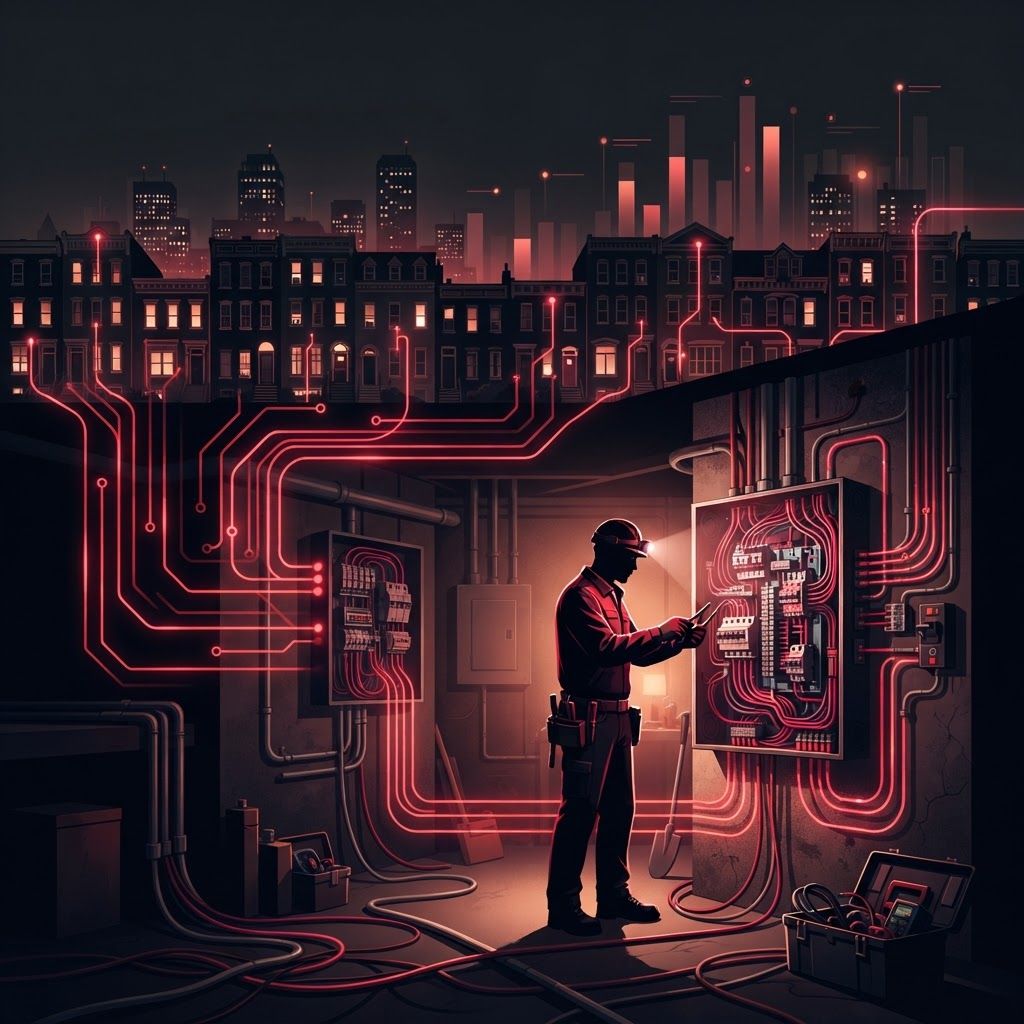
Why Electrical Work in Baltimore Requires Local Expertise
Baltimore is a city of layered building eras. In Federal Hill, Canton, and Fells Point you will find rowhouses built well before the National Electrical Code existed, many of which have been rewired two or three times over the last century. In Harbor East and Port Covington, developers are installing high-density service panels, EV charging infrastructure, and building automation systems that would have been unimaginable a generation ago. An electrician working in Baltimore therefore needs a genuinely wide skill set: the ability to safely trace and replace deteriorated cloth-insulated conductors in a narrow rowhouse chase one day, and to commission a three-phase panel in a new commercial buildout the next.
There is also a regulatory dimension. Maryland licenses electricians at the state level through the Maryland Board of Master Electricians, while Baltimore City maintains its own permitting and inspection process through the Department of Housing and Community Development. Any meaningful electrical work in the city, from a service upgrade to a subpanel addition, requires a permit and a final inspection. Contractors who cut corners on permitting create real problems for homeowners later, particularly at resale or during an insurance claim. The best electricians treat permitting as a non-negotiable part of the job rather than an optional expense.
What Sets the Top Electrical Contractors Apart
The firms that consistently earn strong reputations in Baltimore share several characteristics. First, they employ licensed master electricians who supervise journeymen and apprentices rather than sending unsupervised crews. Second, they carry general liability and workers compensation coverage at levels appropriate to residential and light commercial work, and they will provide certificates without hesitation. Third, they provide written, itemized estimates that separate materials, labor, permit fees, and contingency allowances, so a homeowner can understand exactly what is being purchased.
Diagnostic discipline is the fourth differentiator, and arguably the most important. A flickering circuit can stem from a loose neutral, a failing breaker, an overloaded branch, or a compromised service drop. Cheaper operators replace parts until the symptom disappears. Strong electricians use thermal imaging, insulation resistance testing, and voltage-drop analysis to identify the root cause before quoting a repair. That approach costs more per visit and far less over the life of the home.
The Ten Leading Electricians Serving Baltimore
Baltimore Master Electric has built its reputation on whole-home rewiring in historic rowhouses. The company specializes in phased rewires that let families remain in the home during the project, and it documents every circuit with labeled panel schedules and as-built drawings, which is unusually thorough for residential work.
Charm City Electrical Services is known for responsive residential service work: panel replacements, GFCI and AFCI retrofits, outlet and lighting circuits, and code-correction work flagged during home inspections. Their technicians are frequently praised for clean, low-dust work in occupied homes.
Patapsco Power Solutions focuses on service upgrades and load management, including 100-amp to 200-amp conversions and the load calculations required for heat pumps, induction ranges, and EV chargers. They are a common choice for homeowners electrifying away from gas appliances.
Inner Harbor Electric Company works across residential and light commercial projects, with particular depth in tenant fit-outs for restaurants and retail spaces near the waterfront. Their strength is coordinating electrical scope with HVAC and plumbing trades on tight construction schedules.
Hampden Electric Contractors serves the northern neighborhoods with a small-crew, relationship-driven model. They are frequently recommended for knob-and-tube remediation and for sensitive work in homes with original plaster and millwork that owners want preserved.
Locust Point Electrical Group has developed a niche in smart home integration: structured wiring, network-ready lighting control, whole-home surge protection, and integration with security and climate systems. They are a good fit for owners who want automation installed correctly the first time rather than patched together from consumer devices.
Mount Vernon Electric & Lighting combines electrical licensing with genuine lighting design capability. The firm handles chandelier and sconce installations in historic properties, recessed lighting layouts, exterior and landscape lighting, and dimming systems that avoid the flicker and buzz common in poorly specified LED retrofits.
Federal Hill Emergency Electric operates a genuine around-the-clock service model for outages, burning smells, tripped mains, storm damage, and water-intrusion incidents. Their dispatch discipline and stocked service vehicles allow same-visit repairs on a high percentage of calls.
Canton Commercial Electric concentrates on multifamily buildings, small industrial facilities, and property management portfolios. They provide preventive maintenance programs including infrared panel scanning, torque verification on terminations, and documented annual reporting for owners.
Chesapeake Renewable Electric specializes in solar interconnection, battery backup systems, generator transfer switches, and the utility coordination those projects require. For Baltimore homeowners pursuing resilience against storm outages, this kind of specialized experience matters considerably.
Industry Trends Shaping Baltimore Electrical Work
Three trends dominate current demand. Electrification is the largest: as households replace gas furnaces with heat pumps and add electric vehicle charging, existing 100-amp services are increasingly inadequate. Load management devices and smart panels now offer an alternative to full service upgrades, and knowledgeable electricians will present both options with honest cost comparisons.
Resilience is the second trend. Regional storms and aging distribution infrastructure have made backup power a mainstream request rather than a luxury. Battery systems paired with critical-load subpanels are becoming more common than whole-home standby generators in dense city neighborhoods, largely because of space and noise constraints.
Safety code enforcement is the third. Arc-fault protection requirements, tamper-resistant receptacles, and expanded GFCI coverage have all broadened in recent code cycles. Older Baltimore housing stock rarely complies, and inspection-driven correction work has become a steady category of business.
How to Choose the Right Electrician
Start by verifying the license and confirming the person quoting your job is affiliated with the licensed master electrician on record. Ask for two or three references from projects similar to yours in age and scope of building. Request a written scope that explicitly states whether permits and inspections are included. Be skeptical of estimates that are dramatically lower than others, because the gap almost always represents omitted permits, thinner materials, or unlicensed labor.
Finally, pay attention to communication. Electrical projects in older homes frequently uncover surprises behind the walls. The contractors worth hiring explain what they found, document it with photographs, and present options with clear pricing before proceeding. That transparency, more than any marketing claim, is the most reliable indicator of quality electrical work in Baltimore.
