
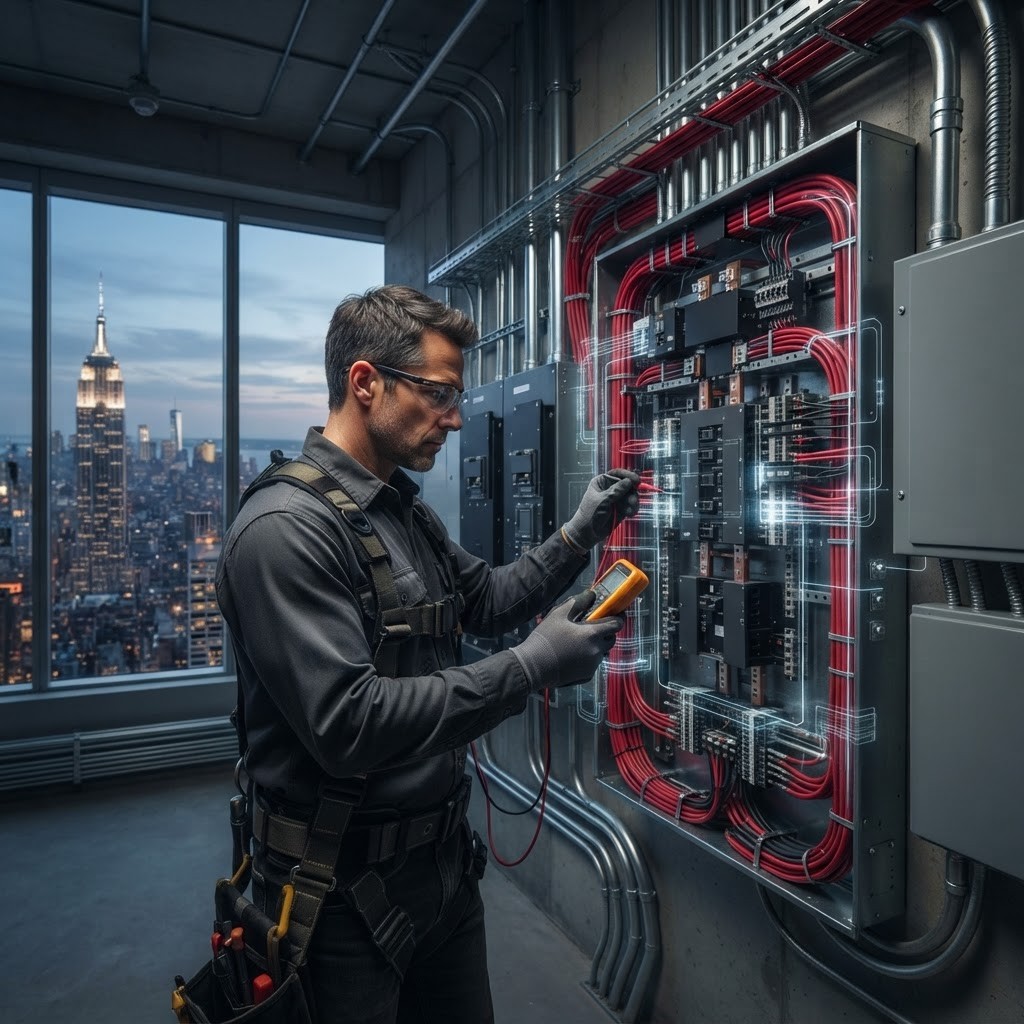
Electrical Work at New York Scale
Electrical construction in New York spans apartment upgrades, corporate fitouts, hospitals, transit systems, data centers, and major infrastructure. The work is highly regulated and often performed in occupied or mission-critical environments. Successful contractors combine licensed supervision, rigorous safety, accurate coordination, reliable procurement, and strong commissioning. The companies below are recognized across different segments of the metropolitan market. Because capabilities vary significantly, owners should match contractor scale and specialization to the actual assignment.
1. E-J Electric Installation Co.
E-J Electric is one of the region's most prominent electrical contractors, with experience in power, communications, transportation, healthcare, and complex infrastructure. Its engineering and field resources suit large, schedule-sensitive programs. The company is especially relevant when electrical work involves extensive coordination, complex phasing, or uninterrupted operations.
2. Five Star Electric
Five Star Electric, part of Tutor Perini, performs substantial electrical work across New York infrastructure, commercial, transportation, and public projects. Its capacity for large labor forces and complicated installations makes it a major-project contender. Owners often consider the firm where scale, union workforce management, and formal controls are essential.
3. Welsbach Electric Corp.
Welsbach has a long history in New York electrical construction and maintenance. Its experience includes transportation, roadway lighting, signals, institutional systems, and public infrastructure. The contractor's familiarity with agency requirements and active public environments is a key differentiator from firms focused mainly on private interior work.
4. Unity Electric Co.
Unity Electric provides electrical contracting, technology systems, and service across commercial and institutional markets. The company can support construction, renovations, maintenance, and communications infrastructure. Its integrated capabilities are useful when power, lighting, fire alarm, security, and low-voltage scopes must be carefully coordinated.
5. Hatzel & Buehler
Hatzel & Buehler is an established electrical contractor with a presence in New York and experience in commercial, industrial, technology, healthcare, and institutional facilities. It is known for handling technically demanding environments. The firm's service and maintenance capabilities can also support clients after construction and commissioning are complete.
6. Forest Electric New York
Forest Electric New York, associated with EMCOR, works on major commercial interiors, buildings, data facilities, and technology-rich environments. The company offers substantial preconstruction and coordination resources. It is particularly relevant for projects where dense overhead services, premium lighting, controls, and accelerated schedules create execution risk.
7. Nead Electric
Nead Electric has extensive regional experience in commercial and institutional electrical work. Its capabilities include power distribution, lighting, fire alarm, communications, and renovation projects. Clients seeking an established local contractor may value its familiarity with New York building conditions and trade coordination practices.
8. Hugh O'Kane Electric Co.
Hugh O'Kane Electric performs electrical contracting and service for commercial properties, institutions, and sophisticated interior projects. The company has a long New York history and offers experience with both new installations and upgrades. Its service orientation is useful where work must be phased around ongoing tenant operations.
9. O'Connell Electric Company
O'Connell Electric supports utility, commercial, industrial, transportation, and renewable-energy projects across New York State. Its broad technical range includes substations, transmission, communications, and building systems. The contractor is a strong consideration when an assignment extends beyond conventional branch power and lighting.
10. Stilsing Electric
Stilsing Electric serves commercial, industrial, institutional, and public clients with electrical construction and maintenance. Its regional experience and varied project portfolio support both planned upgrades and new installations. Owners should review recent projects that match the required voltage, occupancy, controls, and delivery method.
What a Strong Bid Should Include
Electrical proposals should clearly define distribution equipment, feeders, branch wiring, lighting controls, fire alarm, low-voltage interfaces, temporary power, testing, permits, shutdowns, and utility coordination. Compare panel schedules and single-line assumptions, not just totals. Long-lead switchgear, transformers, generators, and lighting packages can drive the critical path, so procurement planning should begin during preconstruction.
Ask contractors to explain their quality process for labeling, torque verification, insulation testing, grounding, and as-built documentation. For occupied facilities, require a written method of procedure for shutdowns and energization. Critical environments may also need infrared scanning, selective coordination studies, load-bank testing, and integrated systems testing.
Technology and Energy Trends
Electrification is changing New York buildings. Heat pumps, electric kitchens, vehicle charging, battery storage, and expanded digital infrastructure can increase loads even as efficient lighting reduces consumption. Contractors must understand service capacity, demand management, metering, and utility requirements. Networked lighting controls and smart panels also make cybersecurity and controls integration more relevant.
Safety and Selection
Review safety performance, training, insurance, workforce availability, and incident procedures. Confirm that the contractor has experience with the building type and can staff the proposed schedule. References should address change management, documentation, commissioning, and closeout—not only installation speed.
Final Perspective
The best electrical contractor brings enough scale for the project without sacrificing attentive management. A complete, coordinated proposal may cost more initially than an incomplete bid but often reduces change orders and commissioning delays. Careful selection protects occupants, supports reliable operations, and creates electrical infrastructure that can adapt to New York's evolving energy demands.
