
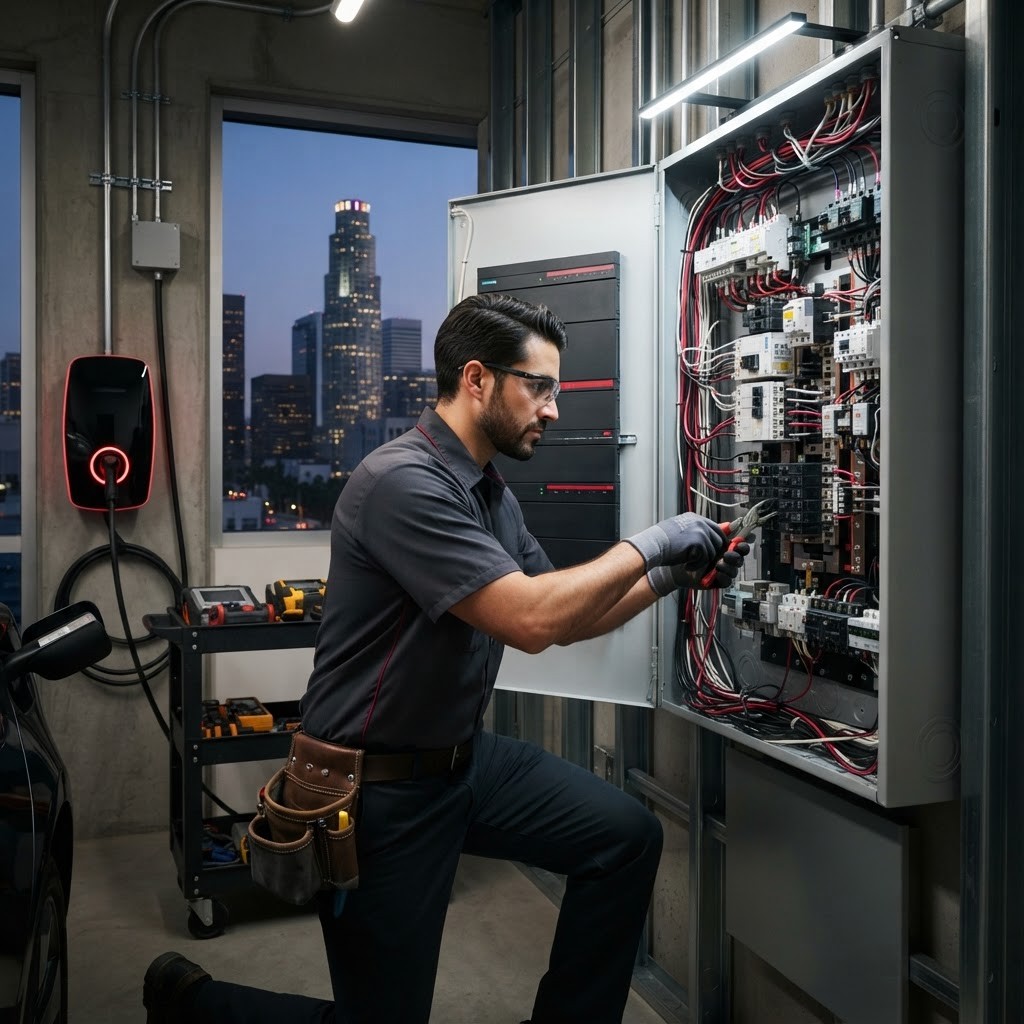
Electrical Contracting in a Changing City
Los Angeles is electrifying rapidly. Building owners are adding electric vehicle charging, solar and storage, heat pumps, intelligent controls, resilient power, and high-capacity data systems while maintaining aging infrastructure. Electrical work must satisfy strict codes, utility requirements, fire-safety standards, and operational constraints. The contractors below include large specialists and established regional providers suited to different project scales. Selection should always be based on relevant experience, available personnel, safety performance, and a clearly defined scope.
1. Rosendin
Rosendin is one of the nation’s largest electrical contractors, with extensive California experience in commercial, data center, transportation, healthcare, renewable energy, and institutional work. Its engineering, virtual design, prefabrication, and commissioning resources are valuable on technically dense projects. The company is particularly relevant when schedule certainty and coordinated field production are critical.
2. Morrow-Meadows Corporation
Morrow-Meadows is a major Southern California electrical contractor serving commercial, healthcare, hospitality, entertainment, mission-critical, and public projects. Its local history and large-project capacity support complex installations and service work. Early involvement can improve routing, equipment planning, procurement, and integration with other building systems.
3. Cupertino Electric
Cupertino Electric delivers electrical construction for data centers, commercial campuses, energy projects, and major infrastructure. Its technology-driven approach and experience with large programs make it a strong candidate for clients requiring sophisticated project controls, prefabrication, and repeatable quality. The company also brings substantial expertise in renewable and distributed energy.
4. Helix Electric
Helix Electric serves multifamily, commercial, industrial, transportation, and mission-critical markets. Its broad field capacity is relevant to high-density Los Angeles development, where repetitive residential installations must still coordinate with complex life-safety and common-area systems. Constructability planning and labor management are key strengths on large projects.
5. Fisk Electric
Fisk Electric has longstanding expertise in electrical and low-voltage systems for commercial, industrial, healthcare, hospitality, and technology environments. Its capabilities extend beyond power distribution to communications, security, and integrated systems. That breadth helps reduce coordination gaps when multiple technology packages share pathways and spaces.
6. SASCO
SASCO is a California electrical contractor known for large commercial, healthcare, entertainment, and complex technical projects. The firm’s preconstruction and engineering resources support cost modeling, constructability, and detailed coordination. Clients with ambitious schedules may benefit from early procurement planning for switchgear, transformers, generators, and controls.
7. Baker Electric
Baker Electric offers electrical construction, renewable energy, storage, and related services across Southern California. Its combined conventional and clean-energy capabilities are useful as owners connect solar, batteries, charging, and building loads. A coordinated energy strategy can prevent equipment incompatibility and avoid underestimating service capacity.
8. Taft Electric
Taft Electric serves Southern California with commercial, industrial, institutional, and infrastructure electrical work. Its regional experience is useful for public works and facilities requiring dependable field execution. Owners should discuss shutdown planning, temporary power, testing, and documentation early when upgrading occupied properties.
9. CSI Electrical Contractors
CSI Electrical Contractors provides electrical construction, energy solutions, and technology systems for commercial, healthcare, education, and advanced facilities. Its integrated approach can support projects where power, controls, communications, and sustainability goals overlap. Detailed digital coordination helps identify clashes before installation begins.
10. Powell Electric
Powell Electric is a recognizable Los Angeles-area service provider for residential and light-commercial repairs, panel work, lighting, troubleshooting, and upgrades. It represents a different project scale from the national contractors above. Homeowners should request written findings, permit details, equipment ratings, and confirmation that service upgrades have been coordinated with the utility.
How to Evaluate an Electrical Contractor
Confirm the proper California license, insurance, bonding capacity, and safety record. For commercial work, review experience with the same occupancy and voltage class. Ask who will lead preconstruction, supervise crews, coordinate inspections, and manage energization. A detailed bid should identify equipment, feeders, branch wiring, controls, low-voltage boundaries, testing, temporary power, utility work, permits, and exclusions.
Electrical equipment lead times can control the entire schedule. Strong contractors identify procurement risks early and assess approved alternates without compromising system studies or warranty. They should also produce accurate record drawings, panel schedules, test reports, training materials, and operation documents. These closeout items are essential for safe maintenance.
EV Charging, Solar, and Resilience
Installing chargers is not simply mounting hardware. Contractors must evaluate available capacity, demand management, conduit routes, accessibility, networking, billing, and future expansion. Solar and battery projects require careful interconnection, protection, fire-code coordination, and commissioning. For critical facilities, generators, transfer systems, microgrids, and storage should be designed around actual operational priorities rather than generic assumptions.
Final Considerations
The right contractor aligns technical capability with project scale. A homeowner troubleshooting a circuit needs a responsive service organization, while a hospital or data center requires deep engineering, quality, and commissioning resources. In every case, safe practices, transparent scope, skilled supervision, and durable documentation should outweigh a low initial number. Thoughtful electrical investment allows Los Angeles buildings to support new technology while remaining safe, efficient, and adaptable.
