
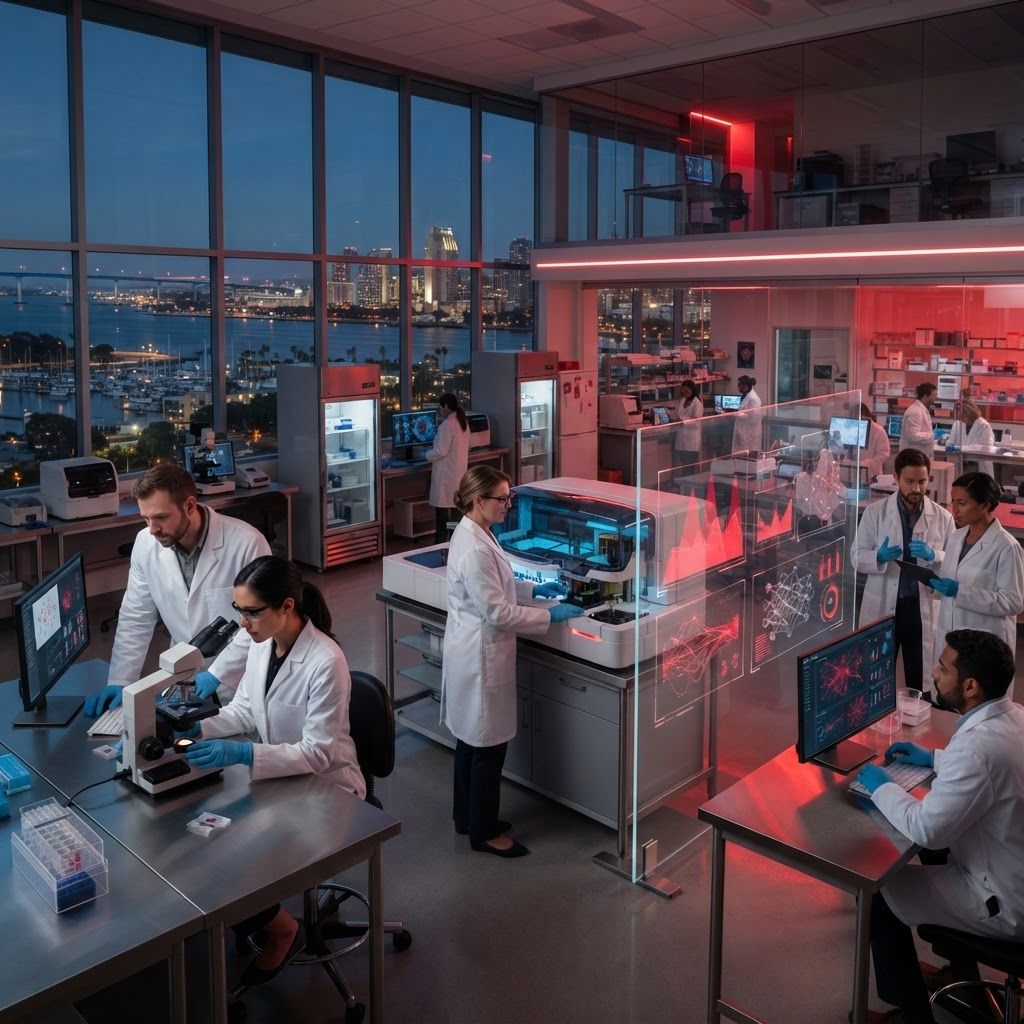
Understanding San Diego's Diagnostic Lab Options
Laboratory results guide decisions ranging from routine cholesterol management to cancer treatment. San Diego patients can use national collection networks, hospital laboratories, public-health services, and highly specialized testing companies. The correct choice usually depends on a clinician's order, insurance network, specimen requirements, and the complexity of the test. The organizations below are notable for access, technical depth, or local specialization. Not every facility accepts walk-ins or serves individual patients, so orders, preparation instructions, and billing should always be verified.
1. Quest Diagnostics
Quest operates patient service centers across the San Diego region and handles a large menu of routine and advanced tests. Online appointment tools, electronic results, and broad insurer relationships make it a common choice for outpatient blood and specimen collection. Its scale supports standardized processes and transport logistics. Patients should confirm fasting requirements and bring the exact order to avoid delays.
2. Labcorp
Labcorp provides another extensive national network with San Diego-area collection sites. Services span routine bloodwork, women's health, genetics, pathology, and specialty diagnostics. Digital scheduling and result access can simplify the experience. Coverage and collection capabilities vary by site, particularly for timed, pediatric, or uncommon specimens, so checking the selected location is important.
3. UC San Diego Health Laboratories
UC San Diego Health's laboratories support outpatient care, hospitals, and an academic medical center. They are especially relevant when testing is connected to a UC San Diego specialist or involves complex interpretation. Integration with the health record helps clinicians see results quickly and compare them with imaging and prior findings. Some sites primarily serve established patients with system orders.
4. Scripps Health Laboratories
Scripps laboratories are distributed through medical offices and hospital campuses in the county. The network supports routine chemistry, hematology, pathology, microbiology, and specialized hospital diagnostics. Patients treated by Scripps physicians benefit from connected records and coordinated follow-up. Parking and appointment procedures differ among neighborhood offices and major campuses.
5. Sharp Laboratory Services
Sharp provides laboratory collection and testing within its San Diego healthcare network. Numerous medical-center locations allow patients to combine lab work with physician visits or imaging. The integrated model supports continuity for chronic-disease monitoring, pregnancy care, and post-hospital follow-up. Patients should identify which site performs their specific ordered test and whether an appointment is needed.
6. Kaiser Permanente Laboratories
Kaiser laboratories are integrated into the care pathway for Kaiser members. Clinician orders, collection, results, pharmacy decisions, and follow-up all occur within the same record system. This can reduce paperwork and make routine monitoring efficient. Access is mainly limited to members, and patients should use the location directed by their care team for specialized collection.
7. ARUP Laboratories
ARUP is a national reference laboratory whose services may reach San Diego patients through hospitals and clinicians rather than retail collection centers. It is known for complex and esoteric testing across genetics, immunology, toxicology, and other specialties. Reference laboratories become important when a local lab cannot perform a rare assay. Turnaround and specimen shipping requirements depend on the test.
8. NeoGenomics Laboratories
NeoGenomics focuses on oncology diagnostics, including pathology, flow cytometry, molecular testing, and genomic analysis. Its work is generally ordered by oncologists and pathology teams rather than consumers. For San Diego patients facing cancer evaluation, specialized laboratories like NeoGenomics can contribute information used to classify disease and evaluate treatment options. Results require interpretation by the treating clinician.
9. Ambry Genetics
Ambry Genetics specializes in hereditary genetic testing and is widely used by healthcare professionals for cancer, cardiac, neurologic, and other inherited conditions. San Diego patients may encounter its services through genetic counselors or specialist offices. Strong counseling before and after testing is essential because results can affect relatives and future care. Insurance authorization and informed consent deserve careful attention.
10. San Diego County Public Health Laboratory
The county's public health laboratory performs surveillance and specialized testing that protects the community, including work related to communicable diseases and environmental threats. It is not a conventional walk-in laboratory; specimens usually arrive through authorized healthcare or public-health channels. Its value lies in outbreak detection, confirmation, and population-level response throughout a busy border and travel region.
How to Evaluate a Laboratory
Confirm that the laboratory is appropriately certified and in network for both collection and analysis. Ask who will interpret the result, how quickly it is expected, and what happens if a specimen is inadequate. Preparation matters: fasting, medication timing, hydration, and collection time can affect accuracy. For genetics and oncology, analytical quality is only part of the decision; clinical interpretation, counseling, and privacy practices are equally important.
Diagnostic Trends in San Diego
Precision medicine, liquid biopsy, molecular infectious-disease testing, and at-home collection are reshaping diagnostics. San Diego's biotechnology sector and academic research community help accelerate adoption of advanced assays, yet newer is not automatically better. A test should answer a meaningful clinical question and have evidence supporting its use. Patients gain the most value when the ordering clinician explains why the test is needed, how results will change care, and whether repeat testing is likely.
