
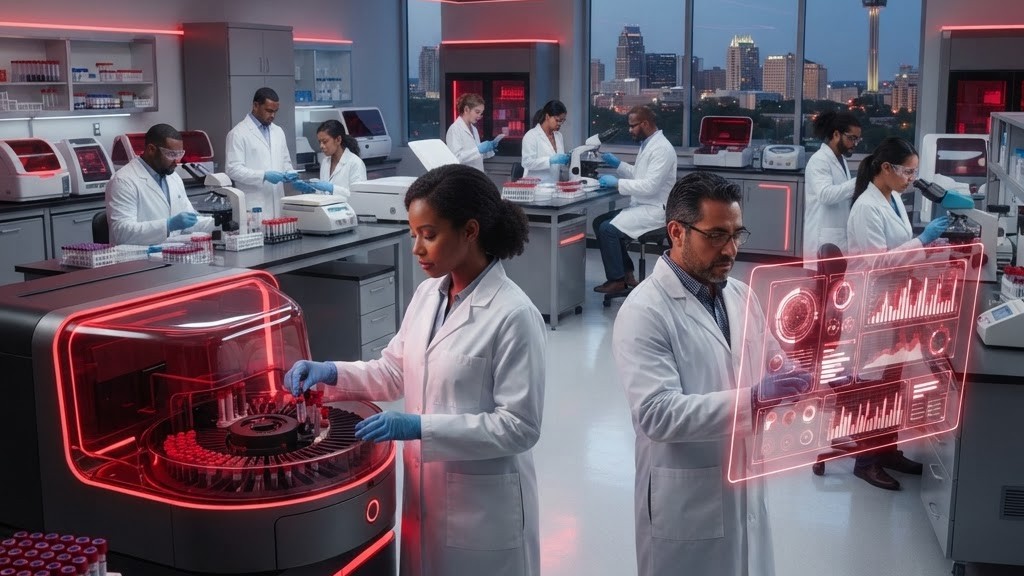
The Role of Diagnostic Laboratories
Laboratory results guide decisions ranging from routine cholesterol management to cancer treatment and infectious-disease care. San Antonio patients encounter national reference laboratories, health-system labs, pathology specialists, and community collection centers. The best choice depends on the ordered test, physician affiliation, insurance network, and whether specialized processing is required.
A convenient draw station is only one part of the process. Accuracy systems, specimen handling, qualified interpretation, secure reporting, and timely communication all matter. Patients should follow ordering-clinician instructions and should not interpret significant results without appropriate medical guidance.
1. Quest Diagnostics
Quest Diagnostics operates patient service centers and provides a broad menu of routine and advanced testing. Online scheduling and result access can simplify common blood work. Its national reference network is useful when patients need continuity across regions, though insurance and appointment availability should be verified.
2. Labcorp
Labcorp offers extensive clinical testing through collection locations and a large national laboratory network. Services range from standard panels to specialized diagnostics. Digital scheduling and reporting support convenience, while broad physician familiarity can make orders and follow-up relatively straightforward.
3. University Health Laboratory Services
University Health's laboratories support outpatient clinics, emergency care, hospital treatment, and specialty programs. Integration with the clinical record can help physicians view results promptly and coordinate next steps. Academic and trauma settings also require the capacity to handle complex, urgent, and highly specialized testing.
4. UT Health San Antonio Laboratories
UT Health San Antonio combines clinical testing with academic expertise across numerous specialties. Its laboratories and pathology services support complex diagnosis, research, and physician education. Patients referred within the system may benefit from close communication among laboratory professionals and specialty clinicians.
5. Methodist Hospital Laboratory Services
Methodist laboratory services support a large hospital and outpatient network throughout the region. Capabilities include routine testing, blood banking, microbiology, pathology, and tests needed for complex inpatient care. Integrated hospital labs are especially important when treatment decisions require rapid turnaround.
6. Baptist Health System Laboratories
Baptist Health System provides laboratory and pathology support across its hospitals and affiliated care settings. A connected network can make results readily available to treating teams and reduce fragmentation. Available outpatient collection services and hours differ by facility and should be confirmed in advance.
7. CHRISTUS Santa Rosa Laboratory Services
CHRISTUS Santa Rosa laboratories serve hospital patients and outpatient clinical needs within the system. Their role spans routine monitoring, emergency diagnostics, surgical pathology, and specialty care. Patients already receiving CHRISTUS care may find the integrated records and clinician coordination helpful.
8. Clinical Pathology Laboratories
Clinical Pathology Laboratories has a strong Texas presence and provides clinical and anatomic pathology services. Its network supports physician offices, hospitals, and patients with a wide range of testing. Local market familiarity and multiple collection options can help streamline routine diagnostic work.
9. Sonic Reference Laboratory
Sonic Reference Laboratory performs high-complexity testing and supports providers requiring specialized diagnostic capabilities. Reference laboratories are essential when a community draw site cannot process an uncommon assay onsite. Their expertise, logistics, and quality systems extend the diagnostic capacity available to San Antonio clinicians.
10. South Texas Pathology Associates
Pathology groups serving South Texas provide physician interpretation of tissue, cytology, and other complex specimens. This work is less visible than a neighborhood blood draw but is central to cancer diagnosis and surgical care. Experience in subspecialty pathology can be a crucial differentiator for difficult cases.
How to Prepare for a Lab Visit
Confirm whether fasting is required and ask whether water and routine medications are permitted. Bring identification, insurance information, and the complete order if it was not transmitted electronically. Good hydration can make a blood draw easier, while accurate timing matters for certain medications and hormone tests.
Before testing, verify that both the collection site and processing laboratory are in network. Ask when results are expected and who will explain them. For unexpected or abnormal findings, the ordering clinician should provide context based on symptoms, history, and other evidence. San Antonio's broad laboratory ecosystem is most effective when accurate testing is paired with clear clinical follow-up.
