
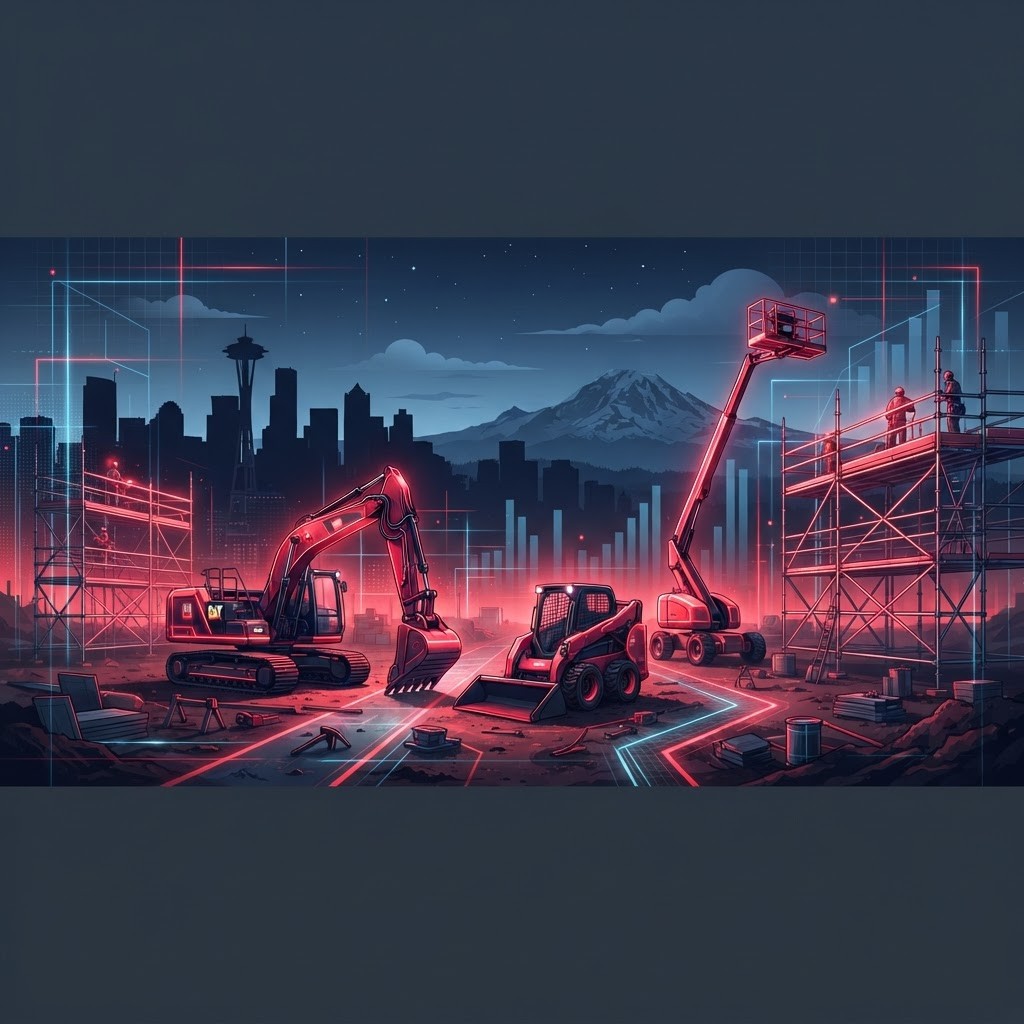
Why Renting Dominates Washington Construction
Washington's construction economy is unusually diverse. Dense urban infill in Seattle and Bellevue demands compact machines that can work in tight footprints. Infrastructure and transportation projects across the I-5 and I-90 corridors call for heavy earthmoving and aerial equipment. Agricultural and energy work in eastern Washington needs telehandlers, generators and water management gear. Very few contractors can justify owning every machine that mix requires.
Renting shifts capital expense into project cost, eliminates storage and maintenance burden, and gives crews access to newer, more fuel-efficient, and lower-emission equipment. It also solves a practical scheduling problem: when a permit slips or weather delays a pour, a rented machine can be released instead of sitting idle on a balance sheet. The providers below have built their businesses around that flexibility.
1. United Rentals
The largest rental company operating in Washington, United Rentals maintains multiple branches across the state and offers one of the broadest catalogs available, from mini excavators and skid steers to boom lifts, trench safety gear, power and HVAC, and specialty tooling. Its scale means substitute machines are usually available quickly when equipment goes down, and its digital account tools make fleet tracking across multiple jobsites straightforward for larger general contractors.
2. Sunbelt Rentals
Sunbelt is a close competitor with strong Washington coverage and a reputation for specialty divisions, including pumps, climate control, scaffolding and industrial tooling. Contractors often choose Sunbelt for projects where a general fleet is not enough and a technical specialist is needed to size equipment correctly. Twenty-four hour support is a frequently cited advantage on schedule-critical work.
3. Star Rentals
Star Rentals is one of the oldest independent rental companies in the Pacific Northwest and remains deeply rooted in Washington. Its branch network covers both sides of the Cascades, and the company is well known for personalized account service, local knowledge, and a fleet balanced between compact equipment for residential builders and larger machines for commercial work.
4. Herc Rentals
Herc serves Washington's commercial and industrial market with earthmoving, aerial, material handling and power generation equipment. The company is frequently used on refinery, utility and large infrastructure projects where documented maintenance records and safety compliance support are contractual requirements.
5. Western Power and Equipment
Focused on heavier construction machinery, Western Power and Equipment supports Washington contractors with excavators, dozers, loaders and related attachments, along with parts and field service. Its dealer-backed technical support is valuable for crews running machines hard on long-duration earthwork.
6. Pape Machinery
A major Pacific Northwest dealer and rental provider, Pape serves construction and forestry markets across Washington. Its rental yards carry excavators, loaders, compaction equipment and attachments, and its service network is one of the most extensive in the region, which reduces downtime on rural and remote sites.
7. NC Machinery
NC Machinery is a long-standing heavy equipment provider in Washington offering rental, rent-to-own and used equipment programs. The company's strength lies in large earthmoving and material handling machines, plus technical support for fleet telematics and productivity monitoring on major projects.
8. Sound Equipment Rental
Serving the Puget Sound region, Sound Equipment focuses on compact and mid-size machines that fit residential remodels, landscaping, utility trenching and small commercial work. Customers appreciate flexible daily and weekend rates and straightforward delivery scheduling for urban sites with limited staging.
9. Kubota and compact equipment dealers across the state
A network of regional Kubota and compact equipment dealers throughout Washington rents mini excavators, compact track loaders, tractors and attachments. For small contractors, landscapers and property owners, these local yards often offer the most practical combination of machine size, price and pickup convenience without the paperwork overhead of national accounts.
10. BlueLine and regional independent yards
Independent and regional rental yards across cities such as Spokane, Vancouver, Bellingham and Yakima fill critical gaps in the market. They typically compete on relationship service, faster local delivery, and willingness to work with smaller contractors on credit terms. For repeat local work, these yards frequently deliver the best total value.
Industry Trends to Watch
Electrification is the biggest change on Washington jobsites. Battery-powered mini excavators, electric scissor lifts and hybrid generators are entering fleets in response to emissions rules, indoor work requirements and noise ordinances in dense neighborhoods. Telematics is the second major trend: GPS and utilization data now travel with rented machines, giving contractors real evidence about idle time and fuel burn. Third, digital rental management has matured, with online reservations, e-signature agreements, and delivery tracking becoming standard expectations rather than premium features.
How to Choose the Right Rental Partner
Begin with fleet age and maintenance discipline. Ask about average machine hours and service intervals, and request recent inspection documentation. Newer equipment costs more per day but generally delivers lower downtime and better fuel efficiency, which usually wins on total project cost.
Clarify what the rate includes. Delivery and pickup, environmental fees, damage waiver, fuel policy and attachment charges can add significantly to a quoted daily rate. Understand how billing periods work, since many yards bill daily, weekly and monthly with sharp breakpoints that reward slightly longer terms.
Evaluate support response. A guaranteed field service window matters more than a small rate difference when a machine is the critical path on a schedule. Confirm operator training and certification support, particularly for aerial lifts and telehandlers where documented training is a safety compliance issue. Finally, inspect and photograph equipment at both delivery and return to avoid damage disputes.
Typical Equipment Categories
Washington rental fleets generally cover earthmoving machines including excavators, dozers, loaders and compact track loaders; aerial equipment such as boom lifts, scissor lifts and telehandlers; compaction and paving equipment; trench shoring and safety systems; pumps and dewatering gear; portable power and light towers; temporary climate control; scaffolding; and a wide range of hand and power tooling.
Final Thoughts
Washington contractors benefit from a mature rental market where national scale and local independence coexist. National providers offer breadth, substitution capacity and account tooling, while regional yards deliver relationship service and faster local response. The strongest strategy for most firms is a hybrid one: a national account for standardized recurring needs, plus a trusted local yard for fast turnarounds and specialty support. Match the provider to the project, read the rate structure carefully, and treat uptime rather than daily price as the real measure of value.
