
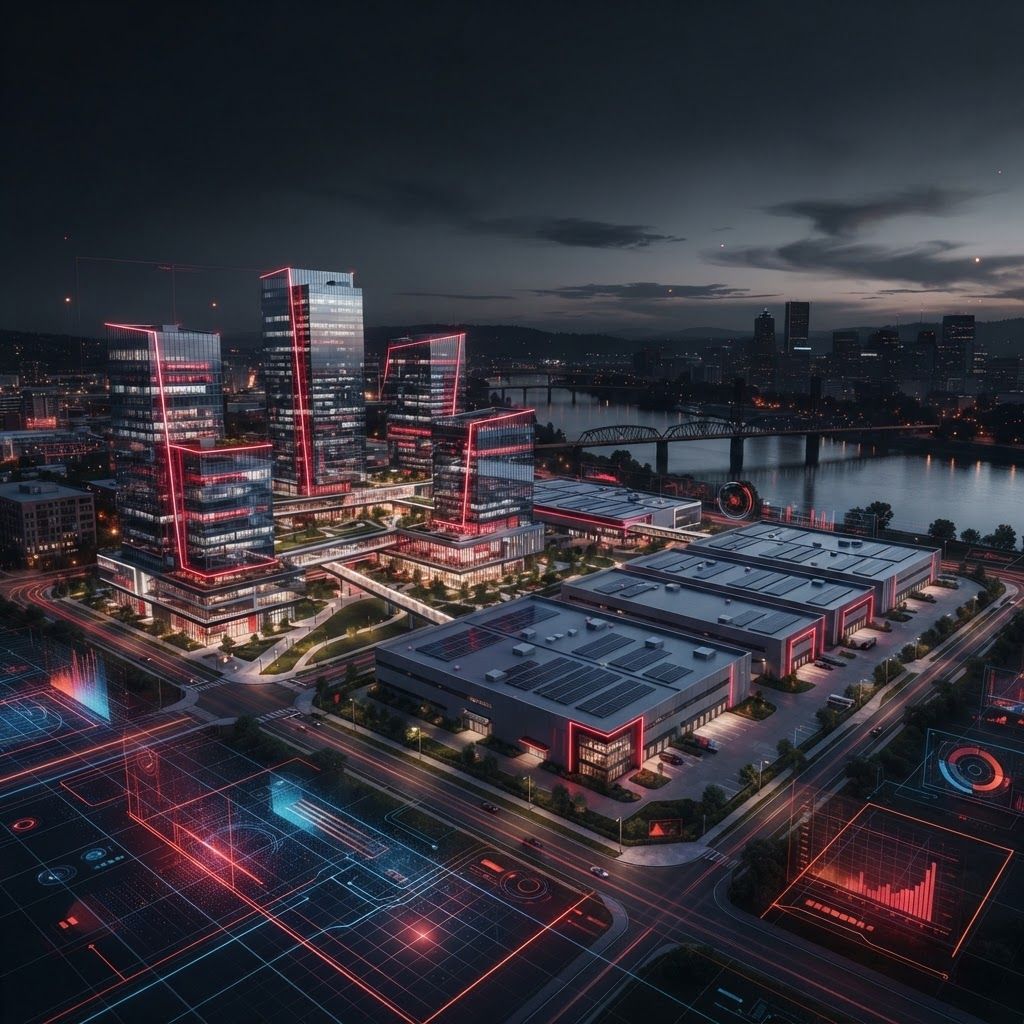
The State of Portland Commercial Real Estate
Portland's commercial real estate market is defined by a sharp divergence between asset classes. Industrial property, particularly warehouse and distribution space near the Columbia corridor, Rivergate, and along Interstate 5 and Interstate 84, has remained structurally strong thanks to the region's logistics advantages and port access. Retail in dense neighborhood corridors has proven resilient. Office, by contrast, continues to work through elevated vacancy following the widespread adoption of hybrid work.
This divergence has changed how brokerage and advisory firms operate. Tenant representation, lease restructuring, capital markets advisory, and property repositioning have all grown in importance relative to straightforward leasing. The strongest firms in the market now function as strategic advisors rather than transaction processors.
Ten Leading Commercial Real Estate Companies
1. CBRE
CBRE maintains one of the largest commercial real estate platforms in Portland, covering brokerage, capital markets, valuation, project management, and property management. Its research capability and national client relationships make it a frequent choice for institutional owners and large corporate occupiers requiring multi-market coordination.
2. JLL
JLL serves the Portland market across office, industrial, retail, and capital markets, with particular strength in corporate occupier services and workplace strategy. As companies continue to right-size footprints, advisory work around space utilization and portfolio consolidation has become a core offering.
3. Cushman and Wakefield
Cushman and Wakefield provides full-service commercial brokerage and asset services in the region, including agency leasing, tenant representation, investment sales, and facilities management. The firm is often engaged for institutional-quality assets and complex industrial requirements.
4. Kidder Mathews
Kidder Mathews is one of the largest independent commercial real estate firms on the West Coast and holds a substantial Portland presence. Independence allows flexibility in commission structures and client alignment, and the firm is well regarded for industrial and mid-market investment sales work.
5. Colliers International
Colliers offers brokerage, property management, and valuation services throughout the Portland metro area. Its entrepreneurial brokerage model has produced strong local specialists in niches such as flex industrial, medical office, and land assemblage for redevelopment.
6. Norris and Stevens
A long-established Portland firm, Norris and Stevens combines commercial brokerage with extensive property management, including multifamily. Locally headquartered firms often bring deeper relationship history with regional owners and a nuanced understanding of submarket dynamics.
7. Melvin Mark Companies
Melvin Mark has operated in Portland for decades as an owner, developer, and manager of downtown commercial property. Firms that own and operate their own portfolio bring practical operational insight that pure brokerage houses cannot always match, particularly in building repositioning.
8. Capacity Commercial Group
Capacity Commercial focuses on the Portland and southwest Washington market with services spanning office, industrial, retail, and investment brokerage. Regionally focused firms of this size frequently excel in the mid-market segment where local knowledge outweighs national platform scale.
9. Marcus and Millichap
Marcus and Millichap specializes in investment sales, with particularly strong activity in multifamily, net-leased retail, and self-storage. Its marketing platform is built to reach private capital investors, which matters in a market where much of the transaction volume comes from individual and family ownership.
10. NAI Elliott
NAI Elliott provides brokerage, property management, and asset management services in the Portland area, with notable retail and mixed-use experience. Firms combining leasing with hands-on management tend to serve owners who want a single accountable partner across the ownership lifecycle.
Asset Class Dynamics
Industrial remains the market's anchor. Portland's position on the Interstate 5 corridor, its deepwater port, and its manufacturing base support sustained demand for distribution, light manufacturing, and cold storage space. Land constraints imposed by the urban growth boundary limit new supply, which supports long-term fundamentals.
Office requires more nuance. Well-located, amenity-rich buildings with modern systems continue to attract tenants, often at improved terms from the tenant's perspective. Older commodity office buildings face difficult economics, and conversion to residential or alternative uses has become a serious topic among owners and policymakers.
Retail has stabilized in neighborhood centers and grocery-anchored formats, where daily-needs tenancy proved durable. Meanwhile, alternative sectors including life sciences space, data centers in the broader region, and self-storage have attracted increasing investor attention.
What Tenants and Investors Should Consider
Tenants should engage representation early, ideally twelve to eighteen months before lease expiration for significant space requirements. Current conditions in several submarkets favor tenants, but capturing that advantage requires competitive alternatives and time to negotiate. Pay close attention to tenant improvement allowances, operating expense structures, escalation clauses, and renewal or expansion rights.
Investors should underwrite conservatively on rent growth and factor in higher debt costs, insurance premiums, and capital expenditure requirements. In Portland specifically, seismic upgrade obligations for unreinforced masonry buildings and energy performance requirements can materially affect capital planning, so due diligence should extend well beyond the rent roll.
Local Factors That Influence Deals
Several Portland-specific considerations recur in commercial transactions. Zoning and design overlays vary significantly by district. System development charges affect redevelopment feasibility. Transportation access, including proximity to light rail and freight routes, drives tenant preferences differently across asset classes. And environmental review is common on formerly industrial sites, particularly in inner eastside and riverfront areas.
Final Thoughts
Portland's commercial real estate market rewards specialization. The right partner depends on your asset class, transaction size, and whether you need national platform capability or deep local relationships. Global firms bring research and institutional reach, while established local companies bring submarket fluency and ownership experience. In a market this segmented, choosing an advisor with genuine expertise in your specific property type is the most consequential decision you will make.
