
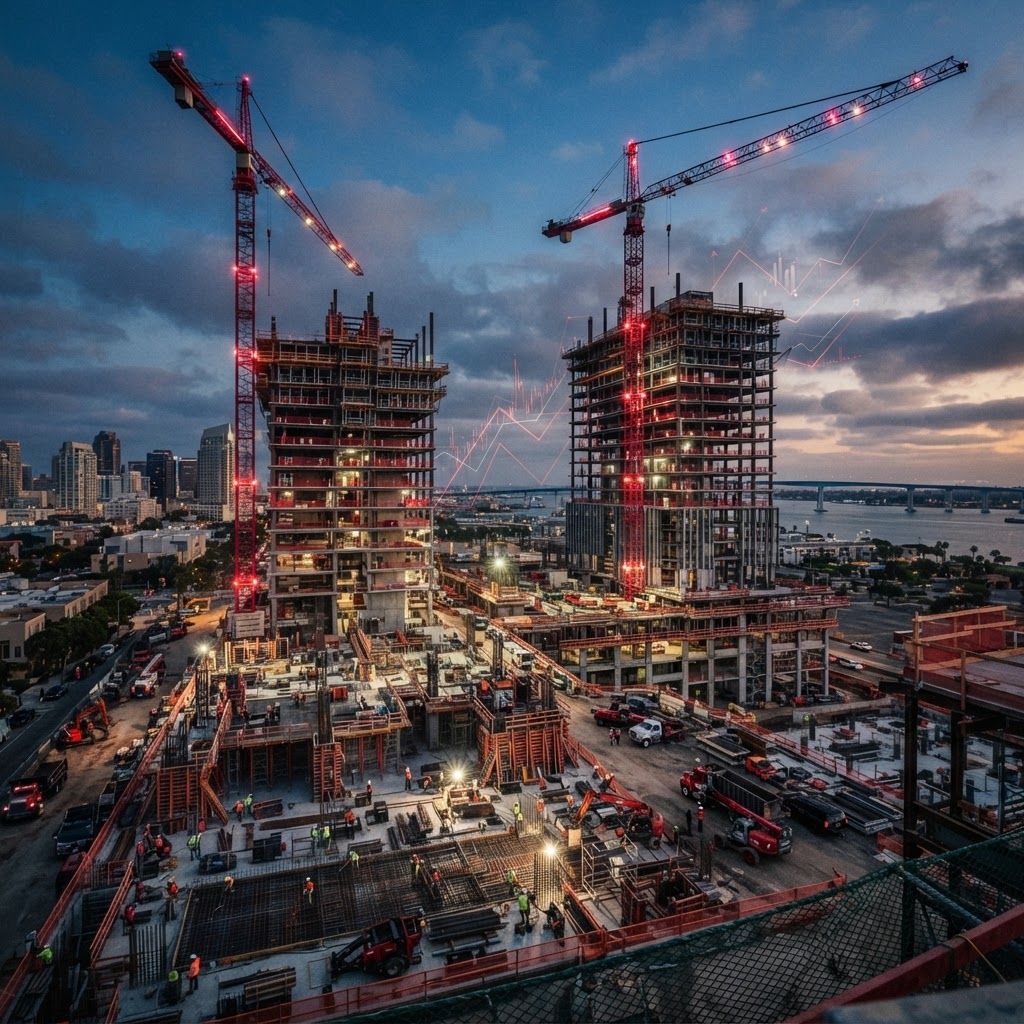
Commercial Building in a Diverse San Diego Market
San Diego's commercial construction market spans biotechnology laboratories, healthcare facilities, hotels, higher education, defense-related workplaces, mixed-use developments, and tenant improvements. Successful delivery depends on early cost intelligence, permitting expertise, logistics planning, safety, and the ability to coordinate specialized systems. The companies below have meaningful regional experience and differing strengths. The list is a starting point for due diligence, not a substitute for project-specific qualification.
Before comparing individual businesses, readers should define the project's location, scope, performance goals, target budget, and desired completion window. Qualifications can change as teams, workloads, and market conditions evolve, so recent references are more useful than reputation alone. Ask each candidate to explain its approach to planning, quality assurance, schedule control, and unexpected conditions. A thoughtful selection process should also consider communication style, documentation, warranty support, and the experience of the people who will actually manage the work. These practical factors often have a greater effect on the finished result than headline price.
1. DPR Construction
DPR Construction is prominent in technically demanding sectors including life sciences, healthcare, advanced technology, and higher education. The contractor is known for collaborative preconstruction, virtual design and construction, and detailed planning around active facilities. Its technical depth can be valuable for projects with complex mechanical systems, laboratories, clean environments, or stringent commissioning requirements.
2. Turner Construction
Turner Construction brings national resources and a substantial Southern California presence to large commercial and institutional projects. Its capabilities include preconstruction, construction management, safety programming, and procurement for major developments. Owners with large teams or complicated stakeholder structures may value Turner's formal controls and reporting practices.
3. McCarthy Building Companies
McCarthy Building Companies works across healthcare, education, science and technology, renewable energy, and civic markets. The employee-owned builder emphasizes self-perform capabilities, constructability analysis, and collaborative project delivery. Its regional experience is relevant for owners seeking a contractor comfortable with complex phasing and critical operational environments.
4. Swinerton
Swinerton serves commercial, hospitality, aviation, education, and mass-timber markets, among others. The company combines a long California history with modern preconstruction and building-technology practices. Its breadth can support projects ranging from detailed interiors to major new construction, particularly where schedule coordination and subcontractor coverage are priorities.
5. Hensel Phelps
Hensel Phelps is recognized for large, technically sophisticated projects and a comprehensive approach that can span development, construction, and facility services. The firm has experience with aviation, government, healthcare, and high-performance buildings. Strong process controls and systems coordination are key differentiators for mission-critical or security-sensitive work.
6. BNBuilders
BNBuilders has a strong profile in life sciences, technology, healthcare, and higher education. Its work often involves occupied campuses, intricate laboratory infrastructure, and accelerated interior programs. The contractor's technology-forward coordination and familiarity with San Diego's research economy can help reduce risk during design development and equipment integration.
7. Rudolph and Sletten
Rudolph and Sletten is a California contractor with experience in biotechnology, healthcare, education, and corporate facilities. The firm is known for delivering complex buildings that demand close collaboration among owners, designers, and specialty trades. It is particularly relevant when quality assurance and sophisticated building systems drive the project.
8. Level 10 Construction
Level 10 Construction operates across commercial offices, mixed-use, hospitality, healthcare, and technology. Its teams emphasize preconstruction, transparent cost management, and field execution for both ground-up and improvement projects. Owners should assess the local team's directly comparable experience, as they should with every large regional builder.
9. PCL Construction
PCL Construction offers extensive resources for commercial, hospitality, civil, and institutional work. The company's planning tools, safety systems, and procurement reach can benefit large developments with demanding schedules. Its diverse delivery experience also supports owners considering design-build or other collaborative contract structures.
10. Burger Construction
Burger Construction is a San Diego-based contractor recognized for tenant improvements, corporate offices, hospitality, healthcare, and specialized interiors. Local relationships and a focus on detail can be advantageous for renovation work in occupied buildings. The firm may be especially relevant when finish quality, phased turnover, and responsiveness are more important than sheer project scale.
How to Evaluate Commercial Contractors
Begin with a project-specific request for qualifications. Review similar work completed by the proposed project executive, superintendent, estimator, and major subcontractors—not only the company's overall portfolio. Ask for evidence of safety performance, financial capacity, quality-control procedures, claims history, and experience with the relevant authority having jurisdiction. A contractor's plan for long-lead equipment, utility coordination, inspections, and occupancy is often more revealing than a generic presentation.
Technology, Sustainability, and Procurement Trends
San Diego owners increasingly expect model-based coordination, reality capture, digital field reporting, and energy-performance analysis. Laboratory and healthcare projects continue to place heavy demands on mechanical and electrical procurement. Meanwhile, embodied carbon, electrification, water use, healthy materials, and construction waste are becoming more prominent in design and tenant requirements. Contractors that involve trade partners early can identify constructability issues and secure critical equipment before they disrupt the schedule.
Choosing for Value, Not Just Bid Price
The lowest bid is not always the lowest final cost. Analyze assumptions, allowances, escalation, general conditions, staffing, and exclusions. Discuss how the team handles design gaps and owner changes. For renovations, insist on investigation of existing conditions and a detailed plan for noise, dust, access, shutdowns, and occupant safety. The best commercial construction partner will demonstrate relevant technical experience, disciplined communication, reliable cost forecasting, and a credible strategy for turning over a safe, complete, operable building.
