
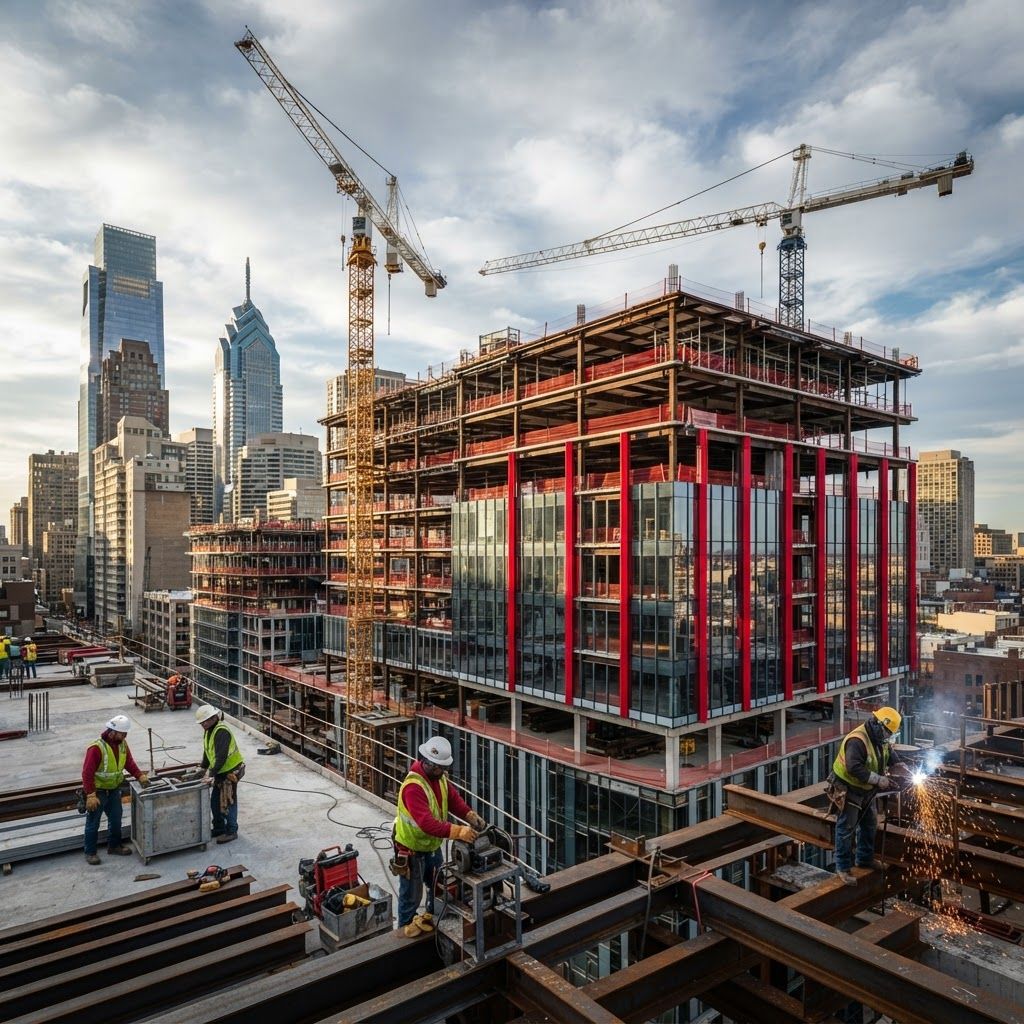
The Strength of Philadelphia’s Commercial Construction Market
Philadelphia combines historic building stock with major healthcare, higher-education, life-science, hospitality, and mixed-use investment. Commercial contractors must work across those conditions while managing safety, cost, procurement, quality, sustainability, and community impact. On occupied campuses and dense city blocks, logistics planning can be as important as physical construction.
The ten firms below are notable for their Philadelphia presence, specialized portfolios, or capacity to deliver complex work. They are not interchangeable. Owners should match contractor experience to delivery method, building type, project size, risk profile, and organizational culture.
1. Turner Construction
Turner Construction is a major national builder with a significant Philadelphia presence and capabilities across commercial, healthcare, education, sports, and technology-intensive facilities. Its scale supports sophisticated project controls, safety systems, and large subcontractor teams. For major programs, owners should examine how national resources will be paired with empowered local leadership.
2. Gilbane Building Company
Gilbane Building Company operates in the region across institutional, commercial, healthcare, and educational markets. Large construction managers add value through preconstruction, estimating, procurement strategy, and formal risk management. The quality of early collaboration often determines whether those resources translate into better field outcomes.
3. LF Driscoll
LF Driscoll is deeply associated with landmark Philadelphia healthcare, cultural, and institutional projects. Work in hospitals and complex occupied facilities requires infection control, shutdown planning, vibration management, commissioning, and close coordination with users. This specialized experience can be more important than general building volume.
4. INTECH Construction
INTECH Construction has built a diverse local portfolio covering commercial interiors, hospitality, residential, education, and cultural projects. Its Philadelphia roots support familiarity with local agencies, design firms, trades, and site constraints. Owners should assess the company’s proposed superintendent and project manager based on directly comparable work.
5. Hunter Roberts Construction Group
Hunter Roberts Construction Group provides construction management for commercial, institutional, residential, and public projects. Urban work benefits from formal logistics studies, phased planning, and early subcontractor involvement. A contractor’s ability to communicate with neighbors and building occupants can prevent operational issues from becoming project disputes.
6. P. Agnes
P. Agnes is a regional builder with strength in healthcare, higher education, life sciences, and corporate projects. These sectors require exacting mechanical, electrical, plumbing, controls, and validation coordination. Owners should involve facilities and operations teams during design and commissioning so the completed systems are maintainable.
7. Clemens Construction Company
Clemens Construction Company has extensive experience in hospitality, mixed-use, multifamily, and commercial development. Hotels and mixed-use buildings combine repetitive rooms or units with complex public spaces, kitchens, vertical transportation, and life-safety systems. Careful mockups and turnover planning can protect both quality and opening schedules.
8. Bittenbender Construction
Bittenbender Construction is a Philadelphia-based, woman-owned contractor with civic, institutional, commercial, and cultural experience. Projects involving public stakeholders benefit from accessible leadership and transparent communication. Its work also demonstrates the important role of diverse firms in the city’s construction economy.
9. Skanska USA Building
Skanska USA Building brings global resources and major-project systems to regional healthcare, education, infrastructure-adjacent, and commercial work. Large firms often invest heavily in safety, sustainability, digital coordination, and standardized controls. Owners should ensure those systems remain practical and responsive at the project level.
10. HITT Contracting
HITT Contracting is known nationally for commercial construction and interiors, with capabilities relevant to corporate, technology, hospitality, and repositioning projects. Interior work can be schedule-intensive because many trades operate in finished spaces at once. Procurement, shop drawings, field coordination, and quality punch processes must move rapidly without sacrificing detail.
Preconstruction Determines Commercial Project Success
Effective preconstruction tests the design against budget, schedule, market capacity, logistics, and operational requirements. Contractors should provide transparent estimates with quantities, assumptions, escalation, allowances, and alternates. Value management should improve the relationship between performance and cost rather than simply removing scope.
Long-lead equipment such as switchgear, generators, air-handling units, elevators, and specialty facade systems can control schedules. Procurement planning may need to begin before the entire design is complete. Early purchases require clear responsibility and careful integration with later documents.
Technology, Sustainability, and Building Performance
Building information modeling helps coordinate structure and systems, while field platforms improve document access and issue tracking. Reality capture can verify progress and concealed work. Technology is effective only when teams maintain accurate information and resolve conflicts promptly.
Philadelphia projects increasingly emphasize energy performance, electrification, healthy materials, stormwater management, and lower operational carbon. Sustainability commitments should be converted into measurable requirements, assigned responsibilities, and commissioning plans. Envelope testing and systems commissioning provide evidence that the finished building performs as intended.
Safety, Diversity, and Community Impact
Review safety performance, site-specific planning, workforce orientation, and subcontractor oversight. A polished corporate program matters less if it is not visible in daily field behavior. Dense sites also require strong pedestrian protection, delivery controls, housekeeping, and emergency planning.
Commercial construction is a major source of local economic opportunity. Owners can establish meaningful participation goals, prompt payment practices, workforce pathways, and reporting requirements. Contractors should demonstrate how commitments will be implemented rather than offering broad statements.
Selecting the Right Commercial Builder
Shortlist firms using comparable project evidence, financial capacity, safety, proposed personnel, preconstruction insight, and references. Interviews should focus on project-specific risks and decision-making, not generic presentations. Clarify delivery method, fee structure, contingency control, change management, schedule ownership, and closeout expectations in the agreement.
Philadelphia has deep commercial construction talent. The strongest choice is the firm that understands the owner’s mission, exposes risk early, builds a capable team, and maintains disciplined communication from estimating through occupancy. That alignment is more predictive of success than company size alone.
