
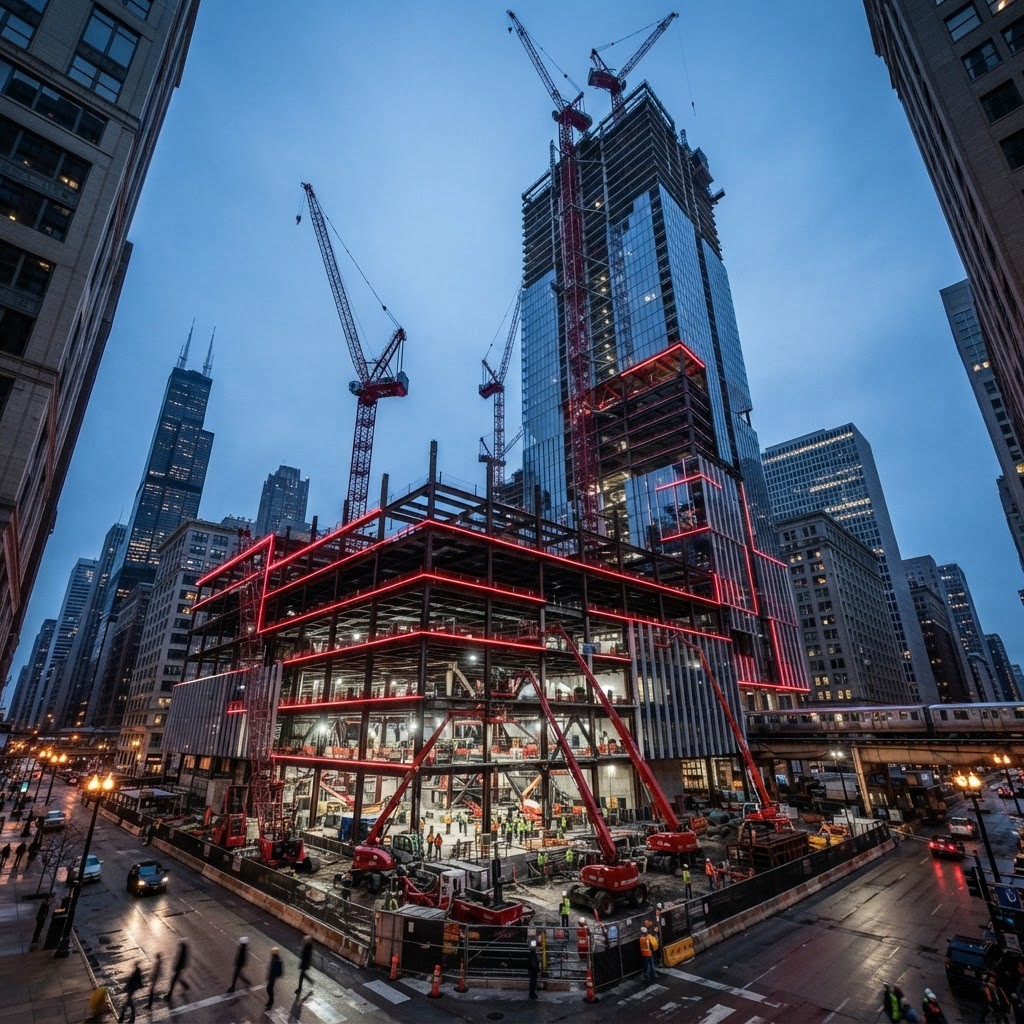
Chicago’s Commercial Construction Landscape
Chicago is a proving ground for commercial builders. Dense streets, active neighboring properties, union labor, complicated structures, and ambitious architecture make planning as important as field execution. Leading contractors invest heavily in preconstruction, safety, building information modeling, logistics, and quality control. The companies below are notable participants in the region, although the right choice depends on sector, contract model, project size, and team compatibility.
1. Power Construction
Power Construction is deeply rooted in Chicago and works across commercial, residential, hospitality, healthcare, and education markets. The firm is known for a relationship-focused model supported by substantial preconstruction and field resources. Its local trade knowledge and understanding of city logistics are particularly useful for projects that must protect surrounding operations while meeting demanding design standards.
2. Walsh Group
Walsh Group is a nationally significant contractor headquartered in Chicago. Its building expertise covers complex commercial and institutional facilities, while broader company capabilities extend into heavy civil construction. Owners benefit from strong safety programs, technical depth, and experience managing large scopes with many stakeholders and rigorous compliance requirements.
3. Clayco
Clayco integrates real estate, architecture, engineering, and construction through a collaborative delivery platform. The company handles major office, industrial, distribution, data, and mixed-use developments. Its design-build capabilities can help align early decisions with cost and constructability, reducing fragmentation between concept and execution on fast-moving commercial programs.
4. Turner Construction
Turner Construction has a substantial Chicago presence and a broad portfolio of high-profile projects. The company’s systems for procurement, scheduling, virtual design, sustainability, and risk management suit technically demanding work. Turner is frequently considered for major developments where reporting discipline, national resources, and specialized market expertise are essential.
5. Gilbane Building Company
Gilbane brings extensive experience in commercial, education, healthcare, and public-sector construction. The firm emphasizes collaborative planning, safety, and technology-enabled delivery. Its teams are accustomed to working within occupied environments and complex approval structures, making the company relevant to phased renovations and facilities where continuity of operations matters.
6. Leopardo Companies
Leopardo is a Chicago-area builder and developer with capabilities across commercial interiors, multifamily, healthcare, retail, and municipal work. Its portfolio ranges from ground-up construction to renovation and tenant improvement. Clients often value the firm’s combination of local market familiarity, flexible project delivery, and attention to service.
7. Skender
Skender is known for commercial interiors, healthcare, multifamily, and advanced building practices. The contractor has cultivated a reputation for lean methods, digital coordination, and a modern workplace culture. Its interiors experience is especially valuable when schedules are compressed and multiple finish, technology, furniture, and occupancy requirements must converge.
8. Pepper Construction
Pepper Construction has longstanding Chicago roots and experience in commercial, institutional, healthcare, and cultural projects. The company emphasizes high-performance construction, quality management, and responsible building practices. Its technical teams are well positioned for renovations where existing conditions and sensitive neighboring spaces require careful investigation.
9. McHugh Construction
McHugh Construction is closely associated with Chicago’s skyline and has delivered prominent high-rise, hospitality, residential, and commercial developments. Its concrete expertise and experience with vertical construction support complicated structures and tight urban sites. The company is a strong candidate where structural planning and tower logistics drive project success.
10. Bulley & Andrews
Bulley & Andrews offers general contracting, restoration, and masonry expertise across commercial and institutional markets. Its historic restoration capabilities distinguish it in a city rich with landmark buildings. Owners undertaking adaptive reuse can benefit from a contractor that understands both contemporary performance requirements and the preservation of significant fabric.
Trends Shaping Commercial Projects
Demand is shifting toward adaptive reuse, lower-carbon materials, all-electric systems, healthy workplaces, and flexible interiors. Industrial and data-related facilities continue to require speed and robust infrastructure, while office owners are repositioning properties with hospitality-inspired amenities. Contractors increasingly use reality capture, coordinated digital models, prefabrication, and real-time field reporting to control uncertainty.
Evaluating a Commercial Contractor
Owners should assess relevant sector experience, proposed personnel, safety performance, financial capacity, and the quality of preconstruction deliverables. Interview the superintendent and project executive who will actually lead the work. Clarify procurement strategy, long-lead equipment, commissioning, change management, and closeout. A capable commercial builder does more than submit a competitive price: it identifies risk early, communicates decisions clearly, and creates a reliable path from design to occupancy.
Planning for a Successful Chicago Project
Before work starts, owners should document existing conditions and define who is responsible for design, permits, material selections, access, protection, inspections, and final cleanup. Chicago schedules should account for building management rules, neighborhood constraints, seasonal weather, and products with long manufacturing lead times. It is wise to keep a reasonable contingency for concealed conditions, especially in older properties. Written meeting notes, current drawings, approved samples, and a shared decision log reduce misunderstandings as work progresses.
References are most useful when they come from recent projects with a similar building type and scope. Ask those clients whether the team maintained the site, communicated upcoming decisions, handled changes fairly, and returned promptly for closeout items. Review the contract carefully and avoid relying on verbal assumptions. Payment milestones should correspond to verifiable progress, while warranties should identify both covered work and the process for requesting service. Finally, remember that a ranked list is a starting point rather than a substitute for due diligence. Availability, staffing, and company focus can change. Interview multiple qualified providers, compare equivalent scopes, verify current credentials, and choose the team that demonstrates technical competence, transparent communication, and a realistic understanding of the project.
