
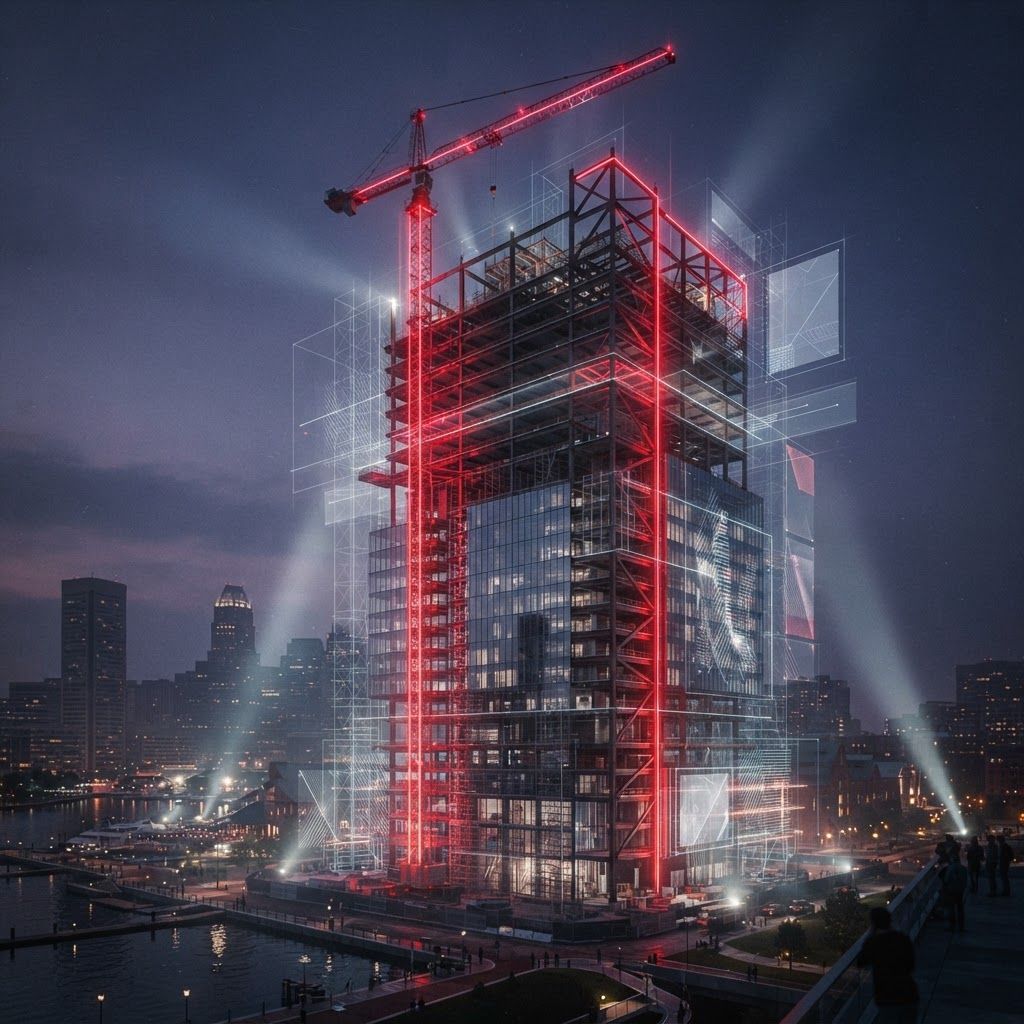
The Shape of Baltimore's Commercial Market
Commercial construction in Baltimore is driven by a distinctive set of economic engines. World-class medical and research institutions generate steady demand for hospitals, clinics, laboratories and academic facilities with exacting technical requirements. The Port of Baltimore and its logistics network fuel warehouse, distribution and cold storage construction. Government and institutional clients at city, state and federal levels commission courthouses, schools and infrastructure-adjacent facilities. And harbor-front redevelopment continues to produce mixed-use projects combining retail, office and residential uses in single structures.
Each of these sectors demands different expertise. A contractor fluent in healthcare infection-control risk assessment and medical gas certification is not automatically equipped for a tilt-up distribution center, and a warehouse specialist may struggle with laboratory fume hood commissioning. The strongest firms in the region are explicit about where their depth lies.
Delivery Methods and Why They Matter
Design-bid-build remains common on publicly funded work, where competitive bidding on completed documents ensures price transparency but limits contractor input during design. Construction management at risk brings the contractor in early to advise on constructability and budget, then converts to a guaranteed maximum price, which suits complex institutional projects. Design-build consolidates design and construction under one contract, compressing schedule and clarifying accountability. Integrated project delivery aligns owner, designer and builder through shared risk and reward, and appears on the most sophisticated projects.
Selecting the right method has more influence on outcome than almost any other early decision. Complex technical facilities generally benefit from early contractor involvement, while straightforward, well-defined buildings can be bid competitively with good results.
The Ten Best Commercial Construction Companies in Baltimore
1. Whiting-Turner Contracting Company, based in the Baltimore area, is one of the largest general contractors in the country and a cornerstone of the regional commercial market. Its capabilities span healthcare, higher education, mission-critical data centers, retail and complex institutional work, supported by mature project controls and extensive preconstruction resources.
2. Gilbane Building Company maintains a significant Baltimore presence with strengths in healthcare, education, science and technology facilities. Firms of this scale bring virtual design and construction capability, detailed logistics planning for occupied campuses and rigorous safety programs.
3. Clark Construction Group works throughout the Mid-Atlantic on large-scale commercial, institutional and infrastructure projects. Its self-perform capability on concrete and structural work gives it schedule control that purely subcontract-based builders cannot match on complex structures.
4. Plano-Coudon Construction serves the Baltimore commercial market with a reputation for collaborative delivery, strong client communication and effective execution on mid-size institutional, commercial and multifamily work.
5. Harkins Builders operates across Maryland with deep multifamily, senior living and mixed-use experience, along with substantial preconstruction services that help owners test feasibility before committing to design.
6. Southway Builders specializes in adaptive reuse, historic rehabilitation and affordable housing throughout Baltimore, work that requires fluency in preservation standards, complex financing structures and the structural realities of century-old buildings.
7. Interior construction and tenant fit-out specialists in Baltimore execute office, medical office, restaurant and retail buildouts. Their competitive advantage is speed and the ability to work in occupied buildings with strict noise, dust and access limitations, often on night and weekend schedules.
8. Industrial and warehouse builders serving the port and I-95 logistics corridor construct tilt-up and pre-engineered metal structures, loading dock systems, heavy slab-on-grade floors and refrigerated facilities. Their expertise in site work, stormwater management and rapid schedule delivery serves a logistics sector where time to occupancy directly drives revenue.
9. Healthcare and laboratory construction specialists in the region handle the most technically demanding commercial work in Baltimore, including operating rooms, imaging suites, containment laboratories and cleanrooms. This work requires infection control protocols, vibration criteria compliance, redundant mechanical systems and extensive commissioning documentation.
10. Regional mid-market commercial contractors based in and around Baltimore serve projects that fall between small interior work and major institutional construction. Bank branches, small medical offices, community facilities and light industrial buildings make up their portfolio, and their responsiveness and lower overhead often deliver better value at that scale.
Trends Reshaping Commercial Construction
Adaptive reuse has become a defining feature of the Baltimore market, converting obsolete industrial and office buildings into laboratories, apartments and community facilities. This approach preserves embodied carbon and neighborhood character while presenting real structural and systems challenges.
Life sciences construction is expanding rapidly, driven by the region's research institutions. Lab-ready buildings require higher floor-to-floor heights, robust mechanical capacity, vibration-controlled structures and flexible utility distribution, and increasingly developers are building shell space specifically to attract these tenants.
Sustainability requirements continue to intensify. Energy code stringency, electrification of building systems, embodied carbon accounting and green certification pursuit now feature in most institutional programs. Meanwhile, prefabrication of mechanical racks, bathroom pods and exterior wall panels addresses persistent skilled labor constraints while improving quality consistency.
On the commercial side of the business, supply chain planning has become a core competency. Electrical switchgear, transformers, chillers and rooftop units carry lead times long enough to dictate the entire project schedule, so contractors now procure these items during design rather than after permit issuance.
How Owners Should Select a Commercial Contractor
Start with sector-specific experience and ask for projects of comparable technical complexity, not merely comparable dollar value. Review safety performance metrics, since strong safety records correlate closely with overall project discipline. Evaluate the actual project team proposed, not just the firm's reputation, because superintendent and project manager quality drives day-to-day outcomes.
Understand the preconstruction offering, including estimating rigor, constructability review and scheduling approach. Confirm bonding capacity relative to project size, review the proposed subcontractor pool and clarify how contingency, allowances and shared savings will be handled. Finally, ask how the contractor manages change: the process for pricing, documenting and approving modifications reveals more about future friction than any interview answer.
Final Thoughts
Baltimore's commercial construction sector combines nationally significant contractors with specialized regional firms, giving owners strong options at every scale and complexity level. Success depends on matching sector expertise to project type, selecting an appropriate delivery method and engaging the builder early enough to influence design and procurement. In a market where lead times and technical requirements increasingly govern schedules, that early alignment is the highest-value decision an owner makes.
