
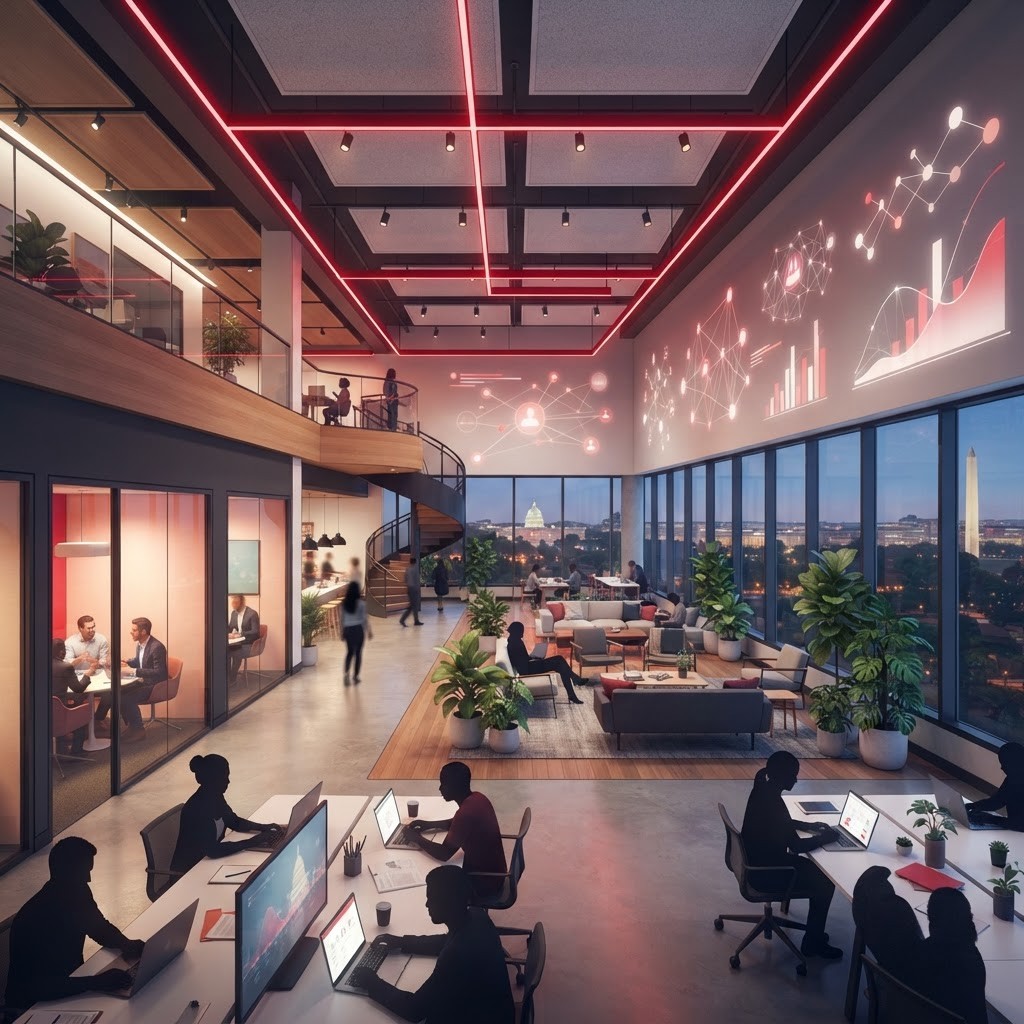
Flexible Workspace Became Essential Infrastructure
Washington's workspace market changed permanently when hybrid work became standard. Companies that once signed ten-year leases for headquarters now maintain smaller core offices supplemented by flexible space near where employees actually live. Simultaneously, the state's large population of independent consultants, remote employees of out-of-state companies, and early-stage founders needs professional environments without long-term commitments.
The geography of demand shifted as a result. Downtown Seattle and Bellevue remain strong, but suburban and secondary markets including Tacoma, Everett, Kirkland, Bothell, Spokane, and Bellingham have seen notable growth. Neighborhood co-working spaces let people work near home while escaping the isolation and distraction of a spare bedroom.
What Distinguishes a Great Co-working Space
Infrastructure comes first. Reliable high-bandwidth internet with wired options, well-designed acoustics, adequate power at every seat, and enough enclosed phone booths for back-to-back video calls are non-negotiable for modern knowledge work. Many otherwise attractive spaces fail on acoustics alone.
Community programming is the second differentiator. The value of shared space rises substantially when it produces useful connections, whether through founder dinners, industry meetups, or informal referral networks. Spaces with intentional curation deliver more than those that simply rent desks.
Practical details matter too: transit access and parking, secure twenty-four hour entry, meeting room availability and credit systems, mail handling and registered agent services, showers for bike commuters, and quality coffee. In Washington, indoor natural light and daylight-friendly design carry extra weight during long gray winters.
The Top 10 Co-working Spaces in Washington
1. WeWork maintains multiple Seattle and Bellevue locations, offering the broadest network access for members who travel. Its private offices, polished common areas, and enterprise-grade services make it a practical choice for growing teams that need to scale headcount quickly.
2. Industrious is known for hospitality-driven service and calm, professional design. Its Seattle-area locations attract established firms and satellite offices that prioritize a quieter, more corporate environment over startup energy.
3. The Riveter, founded in Seattle, built its identity around inclusive community and support for women-led businesses. Its programming, mentorship connections, and thoughtfully designed spaces created one of the region's most distinctive workspace cultures.
4. Impact Hub Seattle serves mission-driven organizations, social enterprises, and nonprofits. Members gain access to a network specifically oriented toward social impact work, along with event space suited to community convenings.
5. CoMotion Labs at the University of Washington supports startups emerging from university research with lab and office space, mentorship, and connections to investors. For science and technology founders, the combination of facilities and institutional network is difficult to replicate.
6. Fuse Coworking and comparable Eastside spaces serve Bellevue, Kirkland, and Redmond professionals who want to avoid crossing the lake. Proximity to major technology employers makes these locations popular with contractors and consultants serving Eastside clients.
7. Regus and Spaces operate widely across Washington, including smaller cities where independent alternatives are limited. Their strength is availability and standardized private office products with predictable terms.
8. Fellow Coworking in Tacoma anchors the South Sound market with a strong local community focus. Tacoma's growing creative and professional services sector has made it one of Washington's most interesting secondary workspace markets.
9. Fellow Spokane options such as Fellow Coworking Spokane and local independents serve eastern Washington's expanding remote workforce. Spokane's lower cost structure has attracted remote employees who want urban amenities without Seattle prices, and its co-working scene grew accordingly.
10. Neighborhood independents across Seattle and Bellingham complete the list. Small owner-operated spaces in Ballard, Fremont, Georgetown, and Bellingham often provide the strongest sense of community, with member rosters small enough that everyone knows one another.
Trends Shaping Washington Co-working
Suburbanization of demand is the clearest shift. Members increasingly want workspace within fifteen minutes of home, which favors neighborhood and suburban locations over central business districts alone.
Enterprise adoption is also significant. Large employers now purchase blocks of flexible desks or floors to give distributed teams gathering places, which stabilizes occupancy for operators and blurs the line between co-working and traditional leasing.
Hybrid-ready meeting technology has become a competitive necessity. Rooms need quality cameras, microphones, and displays configured for mixed in-person and remote participation, and members notice immediately when they do not work.
Finally, specialization is growing. Spaces oriented toward specific industries, from life science wet labs to podcast and video production studios to maker spaces, serve needs that generalist offices cannot.
How to Choose Your Space
Work a full trial day before committing, ideally during a busy midweek period rather than a quiet Friday. Test the internet with a video call, check whether phone booths are available when you need one, and note the noise level around the seat you would actually use. Review the meeting room credit system carefully, since room access often matters more than desk access.
Clarify contract terms, including notice periods, price escalations, and what happens if you need to add or remove seats. Ask about the member mix, because working alongside people in adjacent industries generates far more value than an anonymous room of strangers.
Final Thoughts
Washington's co-working market now offers real variety, from global networks with polished amenities to intimate neighborhood spaces with genuine community. Choose based on commute, acoustic quality, meeting room availability, and member culture rather than aesthetics alone. The right space measurably improves both productivity and professional network, which is a return worth paying for.
