
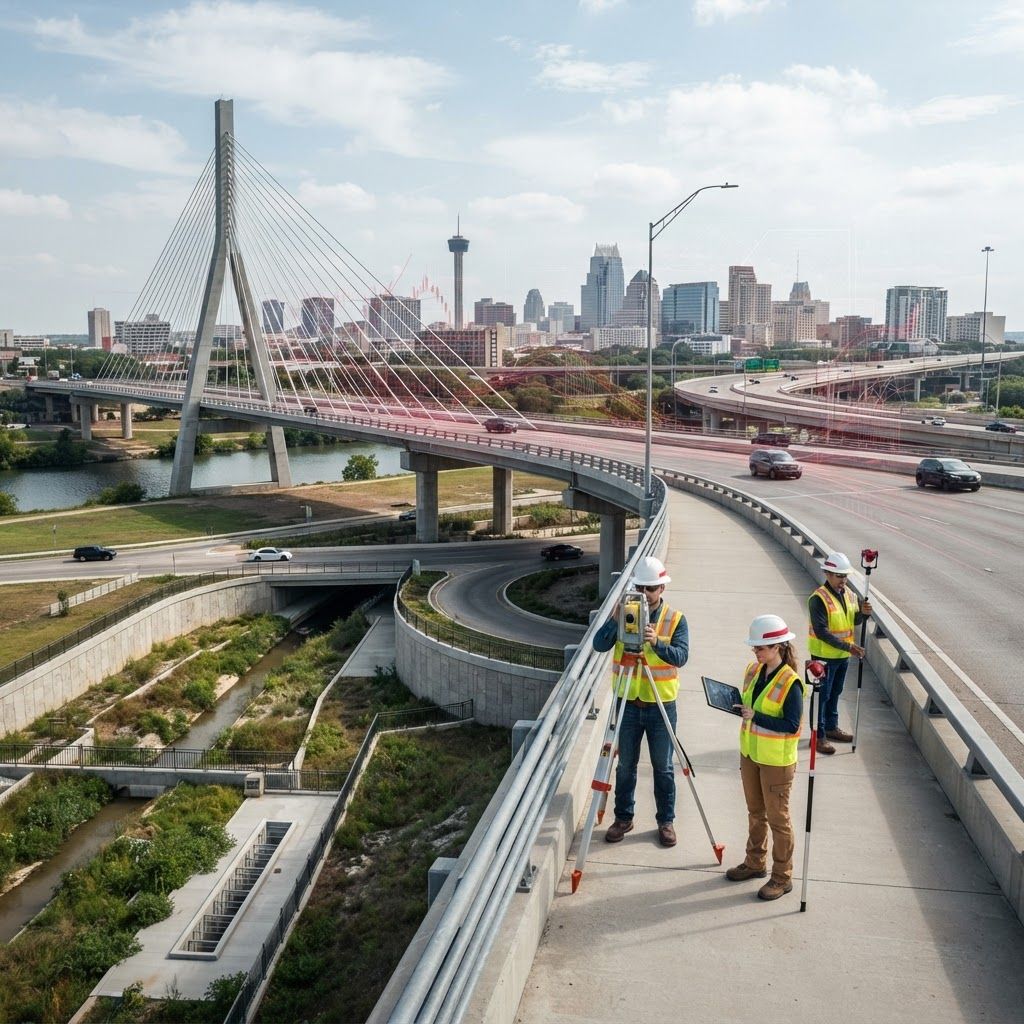
Engineering for San Antonio's Growth
Rapid population growth places pressure on San Antonio's transportation, water, drainage, utility, and development systems. Civil engineering firms help public and private clients turn land and infrastructure needs into safe, permitted, buildable projects. Success requires technical competence, local regulatory knowledge, field awareness, and the ability to coordinate with communities and multiple agencies.
1. Pape-Dawson Engineers
Pape-Dawson Engineers was founded in San Antonio and has become one of Texas's best-known civil engineering firms. Its services span land development, transportation, water resources, surveying, environmental work, and public infrastructure. Deep local experience is especially valuable when a project involves overlapping city, county, utility, and watershed requirements.
2. Kimley-Horn
Kimley-Horn provides planning and engineering services across transportation, land development, water resources, aviation, parking, and urban design. The employee-owned firm's broad national expertise is supported by local teams. It is often considered for complex private development and public assignments requiring multidisciplinary coordination.
3. HDR
HDR is a global architecture and engineering company with strong capabilities in transportation, water, healthcare, and public infrastructure. Large programs can benefit from its technical depth and experience with federal and state processes. Clients should ensure that national specialists are integrated effectively with local project leadership.
4. Freese and Nichols
Freese and Nichols is a Texas-based engineering, planning, and consulting firm with a long history in water, infrastructure, transportation, and public-sector work. Its water resources and program-management experience is relevant to a growing, drought-conscious region. Collaborative planning can help agencies balance immediate needs with long-term resilience.
5. Halff
Halff offers engineering, architecture, planning, surveying, environmental, and landscape-architecture services. The firm's Texas presence and multidisciplinary model support transportation, water, land development, and public-realm projects. Integrated teams can reduce handoff problems when responsibilities and decision authority are clearly defined.
6. WSP
WSP is a global professional-services firm with expertise in transportation, buildings, water, environment, and program management. It can bring specialized resources to major infrastructure initiatives and complicated technical challenges. Local responsiveness and key-person availability should be reviewed when considering a very large organization.
7. Jacobs
Jacobs serves infrastructure, water, transportation, environmental, and advanced-facility markets. Its scale and program capabilities are suited to complex public systems and long-duration capital programs. Clients should seek a clear governance plan defining how strategy, design, stakeholder engagement, and delivery support will connect.
8. Colliers Engineering and Design
Colliers Engineering and Design provides civil, survey, transportation, infrastructure, and development services. For private projects, coordination among site design, entitlements, utilities, and permitting is crucial to maintaining feasibility. Early due diligence can reveal floodplain, access, easement, utility-capacity, and topographic constraints before major investment.
9. Bain Medina Bain
Bain Medina Bain is a San Antonio engineering and surveying firm with experience in transportation, utilities, land development, and public works. A locally rooted firm may offer direct principal involvement and strong familiarity with regional agencies. Its scale can suit clients who value accessible leadership and focused project teams.
10. Poznecki-Camarillo
Poznecki-Camarillo is a San Antonio-based engineering, surveying, and consulting firm active in transportation and infrastructure. Local firms like this contribute valuable knowledge of right-of-way, corridor development, municipal procedures, and community context. Relevant recent experience should be matched carefully to each assignment.
Key Services to Consider
Civil engineering may include feasibility studies, platting, grading, drainage, roadways, traffic analysis, utilities, water and wastewater systems, stormwater controls, surveying, permitting, construction administration, and inspection. Not every firm performs every service in-house. Clients should understand subcontracted disciplines and who remains accountable for coordination.
San Antonio-Specific Challenges
Projects may encounter shallow limestone, sensitive recharge features, floodplains, intense rainfall, drought restrictions, protected trees, historic resources, and rapidly changing traffic. Edwards Aquifer requirements can be especially important in portions of the region. Early environmental, geotechnical, survey, and utility investigations reduce surprises and inform realistic budgets.
How to Select an Engineering Consultant
Review professional registrations, relevant project experience, staff availability, quality-control procedures, insurance, references, and understanding of the approval path. Evaluate the proposed project manager and technical leads rather than relying only on corporate qualifications. A thoughtful scope should define assumptions, deliverables, meetings, agency coordination, survey limits, modeling, bid support, and construction-phase services.
Fee is important, but incomplete scope can create expensive amendments later. Compare level of effort and exclusions carefully. Ask firms to identify major risks and explain how their design will consider maintainability, phasing, sustainability, and lifecycle cost.
Building Better Infrastructure
The right civil engineering partner combines technical rigor with communication and practical judgment. Whether the assignment is a neighborhood, roadway, utility, drainage system, or public facility, careful engineering shapes safety and long-term performance. San Antonio's growth makes that responsibility more important than ever.
Good engineering also considers the people who will operate and maintain the finished asset. Access for inspection, replacement parts, energy use, emergency response, and future expansion should be discussed during design rather than after construction. Lifecycle thinking can produce a project that is not only permit-ready and buildable, but resilient and affordable for decades.
