
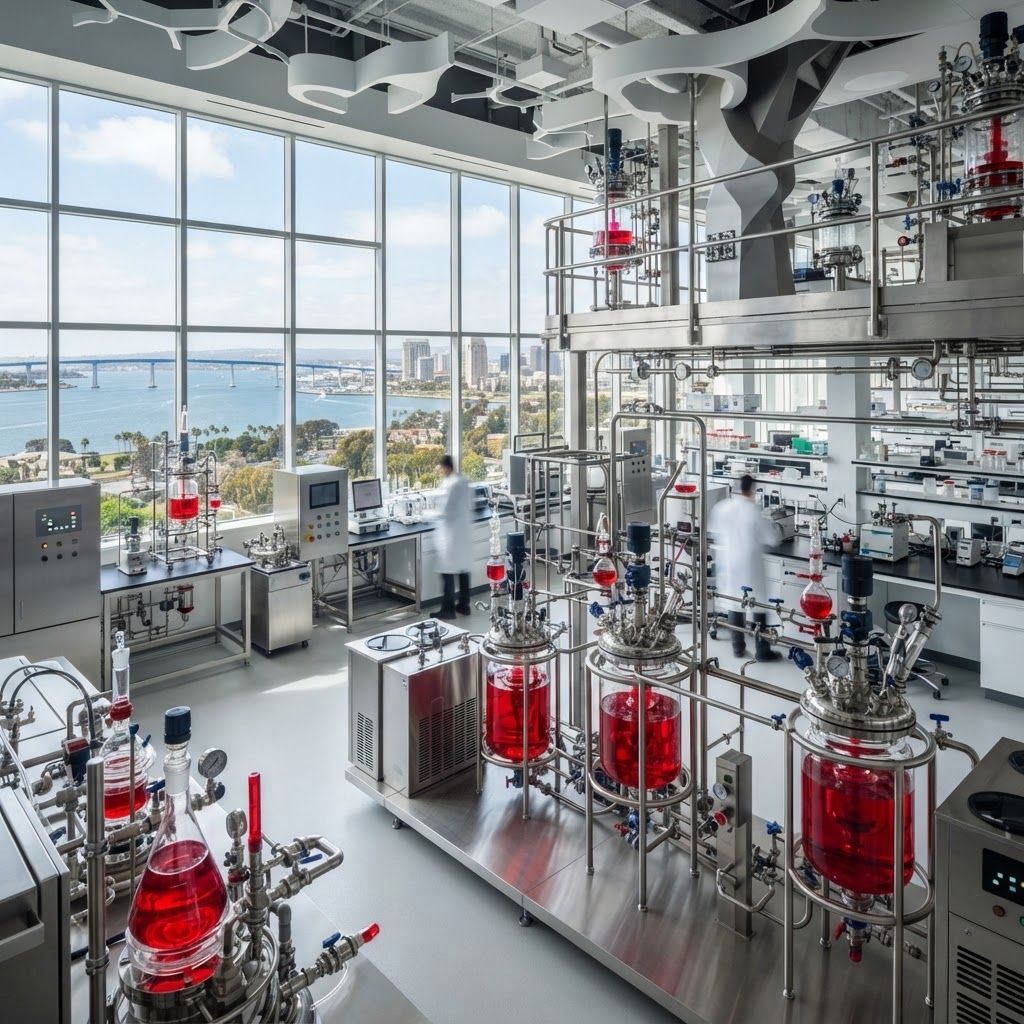
A Specialized Chemical Market
San Diego’s chemical sector differs from the large petrochemical centers found elsewhere. The region specializes in research reagents, diagnostic materials, biochemicals, specialty compounds, and services that support life-science discovery. Proximity to universities, hospitals, biotechnology startups, and established pharmaceutical businesses gives local suppliers a demanding customer base. Quality documentation, consistent purity, cold-chain competence, and responsive technical support are often more important here than commodity-scale volume.
1. Thermo Fisher Scientific
Thermo Fisher Scientific maintains significant operations in the San Diego life-science community and supplies chemicals, reagents, instruments, and laboratory essentials. Its broad catalog allows research and manufacturing teams to consolidate purchasing while accessing established quality systems. The company is particularly relevant to customers that need continuity across discovery, development, and regulated production. Global logistics and technical resources also help laboratories manage complex workflows and standardize materials across locations.
2. Illumina
Illumina is best known for sequencing systems, but chemistry is central to its technology. Reagent kits, flow-cell chemistry, and carefully controlled consumables enable reliable genomic analysis. The San Diego-based company stands out for integrating chemical formulations with instruments, software, and bioinformatics. This complete-platform model has influenced the region’s wider supplier base, creating demand for high-purity inputs, specialized packaging, clean manufacturing, and rigorous quality control.
3. BioLegend
BioLegend, part of Revvity, develops antibodies, proteins, buffers, and reagents used in biomedical research. Its San Diego operations support scientists working in immunology, cancer research, neuroscience, and cell biology. The company’s strength lies in application-focused products backed by technical knowledge and lot-to-lot consistency. For laboratories, dependable performance can reduce repeat experiments and accelerate decisions, making reagent quality a meaningful contributor to research productivity.
4. Enzo Life Sciences
Enzo Life Sciences supplies labeling and detection technologies, assays, proteins, antibodies, and biochemical tools. Its portfolio supports research into cellular pathways and disease mechanisms. The business is notable for connecting chemical expertise with practical laboratory applications. Researchers evaluating suppliers should consider not only product specifications but also validation data, protocol clarity, storage stability, and the availability of compatible products that simplify experimental design.
5. Abcam
Abcam serves San Diego’s research community with antibodies, proteins, cellular assays, and biochemical reagents. Its emphasis on product data and validation responds to a persistent challenge in life sciences: reproducibility. A reagent that performs consistently across experiments can save substantial time and resources. Abcam’s broad application coverage also makes it useful to multidisciplinary groups that need a common supplier for imaging, immunoassays, flow cytometry, and protein analysis.
6. AAT Bioquest
AAT Bioquest develops fluorescent dyes, probes, assay kits, and detection reagents. Located in the San Diego area, the company serves scientists who need sensitive tools for measuring cellular activity and molecular interactions. Its specialization in fluorescence chemistry provides a clear differentiator. As laboratories adopt higher-content imaging and more complex multiplex assays, suppliers capable of optimizing brightness, stability, and compatibility become increasingly valuable.
7. G-Biosciences
G-Biosciences offers reagents and kits for protein research, sample preparation, electrophoresis, and molecular biology. The company supports academic, biotechnology, and pharmaceutical laboratories with practical products used throughout routine workflows. Its value proposition centers on breadth and accessibility. Laboratories often benefit from suppliers that can provide both specialized chemistry and dependable everyday consumables, reducing administrative effort while maintaining experimental consistency.
8. Biosynth
Biosynth supplies complex chemicals, biochemicals, reference materials, and custom synthesis services to life-science and diagnostic organizations. Custom capability is especially important when commercial catalogs cannot meet a project’s purity, scale, or structural requirements. The company’s model supports early research as well as later-stage development. Buyers considering custom chemistry should assess analytical documentation, confidentiality controls, scale-up planning, and the supplier’s ability to maintain specifications over repeated batches.
9. Genesee Scientific
Genesee Scientific is a San Diego-based laboratory supplier with chemicals, reagents, plasticware, and equipment used by research institutions. Its local roots and broad distribution role make it a practical resource for laboratories balancing speed, service, and purchasing efficiency. A responsive distributor can help teams handle urgent needs, product substitutions, and supply disruptions. That operational support is particularly important in fast-moving research environments where delayed materials can interrupt entire study schedules.
10. Cosmo Bio USA
Cosmo Bio USA distributes specialized research reagents from a wide network of manufacturers, helping North American scientists access niche products. Its San Diego presence connects the region to international life-science innovation. The company is especially useful when a project requires uncommon antibodies, assay kits, or biological materials. Curated distribution expands choice while giving customers a domestic channel for ordering and support.
Choosing a Chemical Supplier
Customers should verify purity, analytical methods, safety documentation, storage requirements, traceability, shelf life, and suitability for the intended application. Regulated manufacturers must also examine change notifications, quality agreements, audit readiness, and long-term availability. Price matters, but failed experiments or interrupted production usually cost far more than the material itself. Trial quantities and side-by-side qualification can help teams make evidence-based choices.
San Diego Industry Trends
Growth in cell therapy, genomics, spatial biology, diagnostics, and biomanufacturing is increasing demand for specialized chemistry. Sustainability is also influencing solvent selection, packaging, and waste reduction. Suppliers that combine scientific expertise with reliable logistics and transparent data will remain well positioned. San Diego’s collaborative life-science environment makes it an effective market for companies that can move quickly without compromising quality.
