
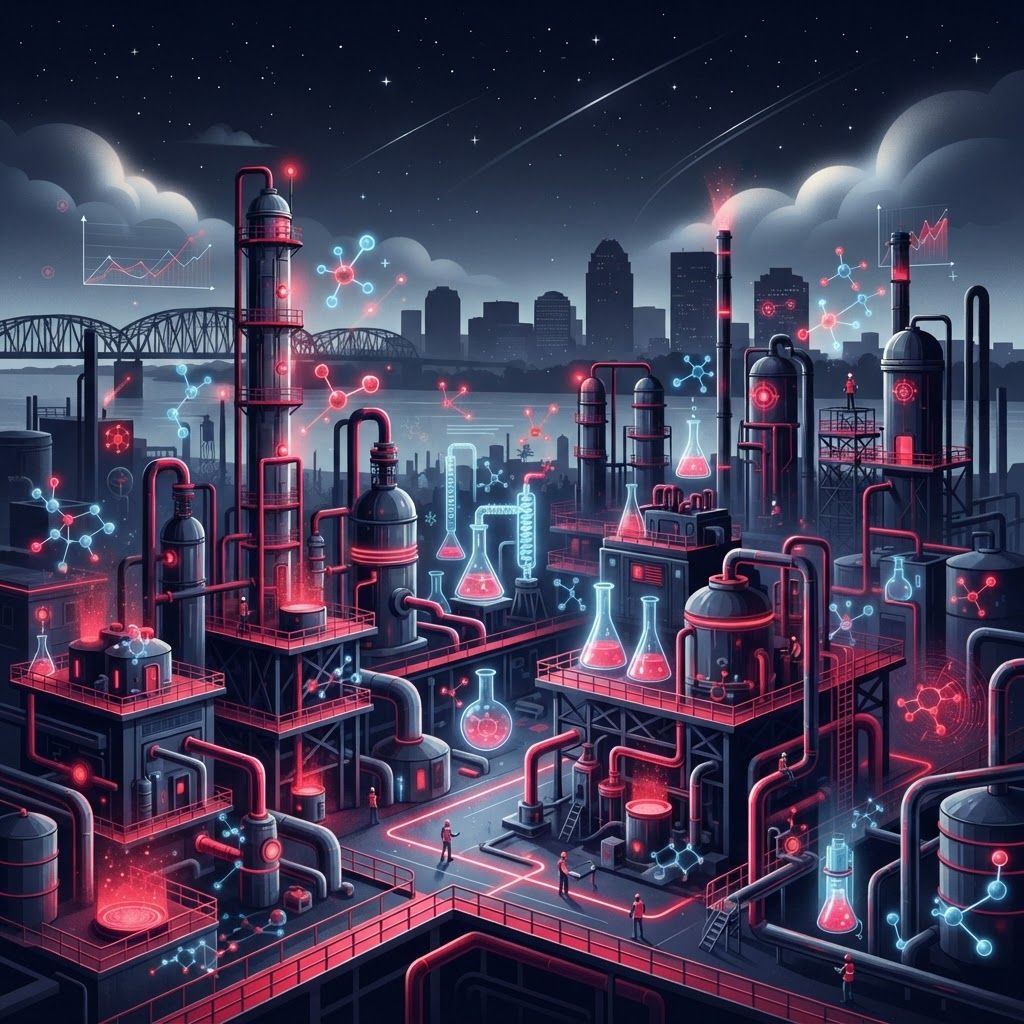
Louisville's Deep Roots in Industrial Chemistry
Few American cities have a chemical history as concentrated as Louisville's. During the Second World War, the federal government built synthetic rubber capacity along the Ohio River in what became known as Rubbertown, and the infrastructure created then, including river access, rail spurs, steam utilities, and wastewater capacity, remains a competitive advantage. Today that western Louisville corridor hosts a cluster of specialty chemical, polymer, and gas producers operating side by side.
The modern sector looks different from its mid-century predecessor. Instead of a handful of enormous commodity plants, Louisville now supports a mix of global specialty chemical operations, contract manufacturers, distributors, catalyst producers, and coatings formulators. Many serve regional customers in automotive, appliance, packaging, agriculture, water treatment, and bourbon production.
The Top 10 Best Chemical Companies in Louisville
1. American Synthetic Rubber Company
Operating from the heart of Rubbertown, American Synthetic Rubber Company produces solution styrene butadiene rubber used in high-performance tires and industrial goods. The plant is valued for consistency of polymer properties, a critical factor for tire makers balancing rolling resistance against wet grip. Its long operating history has produced deep process knowledge that is difficult to duplicate.
2. Zeon Chemicals
Zeon Chemicals maintains major manufacturing and technical operations in Louisville, producing specialty elastomers including nitrile and acrylic rubbers engineered for heat, oil, and chemical resistance. Automotive sealing, hoses, and gaskets rely heavily on these materials. Customers consistently praise the company's applications laboratory and willingness to co-develop compounds for demanding service conditions.
3. Clariant Catalysts
Louisville has long been a catalyst manufacturing center, and Clariant's local operations continue that tradition with catalysts for petrochemical, refining, and emissions applications. Catalyst production demands extraordinary control over surface chemistry and particle structure, making the site a showcase for precision process manufacturing. Technical service and regeneration support add lifecycle value for customers.
4. Chemours Louisville Works
The Louisville Works site produces fluorochemical intermediates and specialty materials used across refrigeration, electronics, and industrial processing markets. Sites of this scale bring rigorous process safety management, extensive environmental controls, and engineering resources that smaller producers cannot match. Reliability of supply is a defining reason customers stay for decades.
5. Arkema Louisville Operations
Arkema's local presence contributes specialty additives and polymer processing aids serving construction, coatings, and plastics customers. The company is recognized for sustainability-driven product development, including low-emission formulations and bio-based alternatives. Global research backing combined with regional manufacturing gives customers both innovation and shorter lead times.
6. Falls City Specialty Chemicals
This regional formulator blends and packages cleaning chemistries, water treatment programs, and lubricants for industrial and institutional customers. Its strength is customization: small batch sizes, private labeling, and rapid reformulation when a customer's substrate or process changes. Onsite technical visits and operator training set it apart from purely transactional suppliers.
7. Ohio Valley Chemical Distribution
A distributor rather than a producer, this company stocks acids, caustics, solvents, and specialty additives for manufacturers across Kentucky and southern Indiana. Value comes from inventory depth, bulk delivery capability, drum and tote logistics, and compliant waste container return programs. For mid-sized plants, a strong local distributor often matters more than a direct mill relationship.
8. Bluegrass Coatings and Resins
Serving furniture, metal fabrication, and building products manufacturers, this formulator produces industrial coatings, adhesives, and resin systems. Low-VOC and waterborne technologies now represent a growing share of its portfolio as customers respond to air quality regulations. Color matching turnaround and application troubleshooting are noted strengths.
9. River Region Industrial Gases
Industrial gas supply underpins welding, food packaging, medical facilities, and process manufacturing across the metro. This supplier provides bulk and cylinder nitrogen, oxygen, argon, carbon dioxide, and specialty mixtures along with tank installation and telemetry monitoring. Reliable delivery scheduling is the primary reason customers cite for loyalty.
10. Derby City Laboratory Chemicals
Supporting universities, hospitals, testing laboratories, and quality departments, this company supplies reagents, analytical standards, and laboratory consumables. Certificates of analysis, proper cold chain handling, and hazardous shipping expertise are the core competencies. Its responsiveness on small urgent orders makes it a favorite among research teams.
Safety, Compliance, and Community Expectations
Chemical manufacturing in Louisville operates under unusually visible scrutiny. The Strategic Toxic Air Reduction program, administered locally, established emissions requirements that exceed many federal baselines, and area facilities participate in coordinated emergency planning with neighborhood councils and first responders. The practical result is that credible Louisville chemical companies invest heavily in process safety management, leak detection, containment, and community communication.
Buyers should treat this as an advantage rather than an obstacle. A supplier with mature safety systems is far less likely to experience the unplanned outages, regulatory shutdowns, or product quality excursions that disrupt downstream production. Ask directly about incident rates, management of change procedures, and third-party audit results.
Trends Reshaping the Sector
Sustainability is the dominant force. Customers increasingly request bio-based feedstocks, recyclable formulations, reduced solvent content, and documented carbon footprints. Second, digitalization of plants through advanced process control and predictive maintenance is improving yield and uptime. Third, supply chain resilience has changed sourcing behavior, with many manufacturers deliberately qualifying domestic or regional second sources after recent global disruptions.
How to Select a Chemical Supplier in Louisville
Begin with technical fit. Confirm specification ranges, impurity profiles, and lot-to-lot variability rather than accepting a generic datasheet. Request samples large enough for a real production trial, and involve your quality team early. Next, evaluate logistics practicalities: packaging formats, minimum order quantities, delivery windows, and how the supplier handles urgent requirements.
Finally, weigh technical service heavily. In specialty chemistry, the difference between a good and a great supplier is usually the applications engineer who visits your plant, diagnoses a problem you had accepted as normal, and adjusts a formulation accordingly. That relationship generates far more value over time than a marginal price concession.
Conclusion
Louisville's chemical sector combines global-scale manufacturing with nimble regional formulators and distributors, all supported by exceptional river, rail, and air logistics. Whether you need engineered elastomers, catalysts, coatings, industrial gases, or laboratory reagents, the metro area offers experienced options with strong safety cultures. Match your technical requirements and service expectations carefully, and Louisville can supply chemistry partners built for the long term.
