
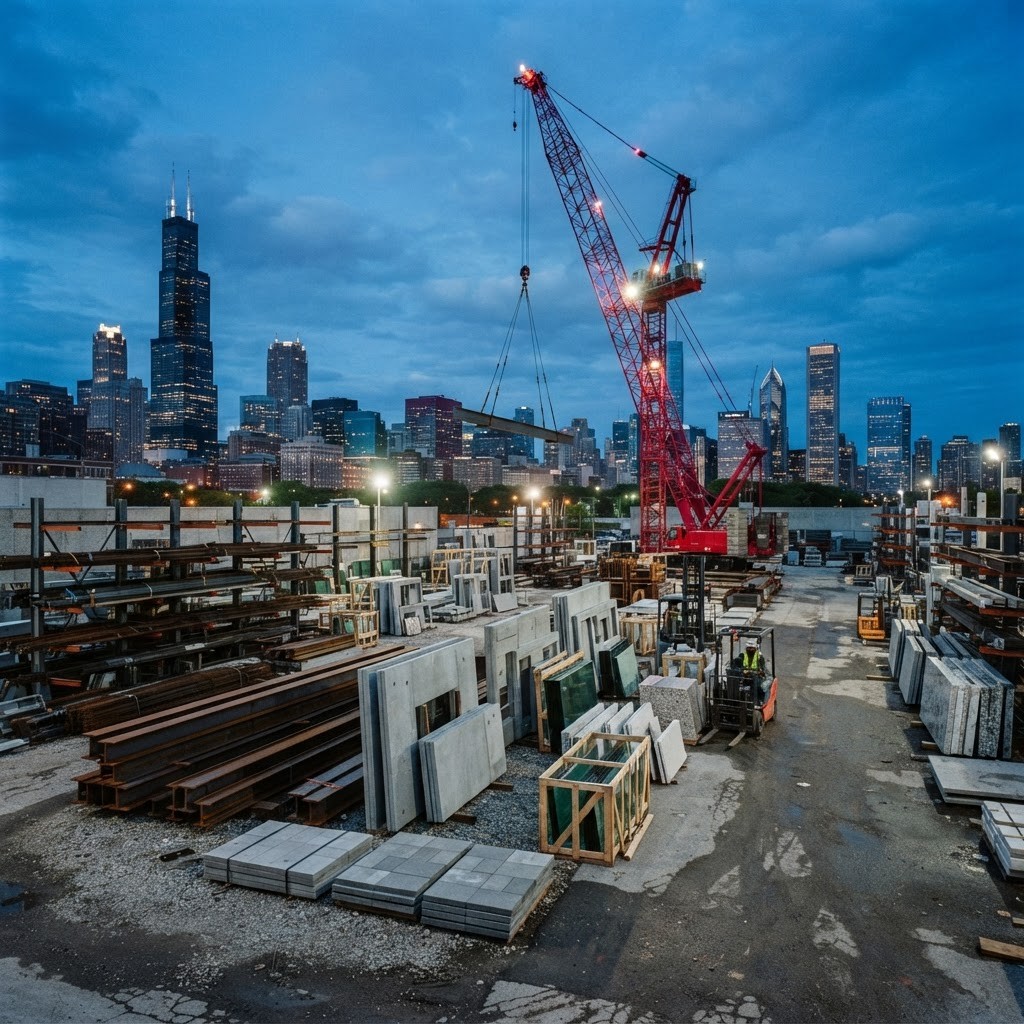
Building for Chicago Conditions
Chicago construction must respond to freeze-thaw cycles, summer heat, wind, moisture, dense urban logistics, and a building stock ranging from historic masonry to contemporary towers. Material selection affects energy use, durability, maintenance, installation speed, and architectural character. The city's strong construction market is supported by manufacturers, distributors, and specialty suppliers with knowledge of local codes and field conditions.
The best building material company provides more than inventory. Contractors and designers benefit from accurate takeoffs, submittal support, technical data, realistic lead times, jobsite delivery, and help resolving compatibility questions. This list includes companies serving different parts of the assembly, so the most suitable partner will depend on project type and scope.
1. USG Corporation
Chicago-based USG is one of the most recognized names in gypsum panels, ceilings, joint systems, and interior construction materials. Its products are widely specified in residential, commercial, healthcare, and institutional work. USG's technical resources help teams address fire resistance, acoustics, moisture exposure, finishing quality, and installation efficiency. Its deep local history makes it a defining part of Chicago's building-material sector.
2. LafargeHolcim
LafargeHolcim has substantial operations serving the Chicago market with cement, aggregates, ready-mix concrete, and related solutions. These materials form the structural foundation of buildings and infrastructure across the region. Mix design, placement conditions, curing, strength development, and environmental targets all require coordination. A large integrated producer can support demanding volumes and provide technical input for specialized concrete performance.
3. Ozinga
Family-owned Ozinga is closely identified with Chicago construction and supplies ready-mix concrete, aggregates, and logistics services. Its familiar red-and-white trucks are a longstanding presence on local jobsites. The company's regional plant network supports timely delivery, which is critical because concrete quality and placement depend on careful scheduling. Ozinga's knowledge of local contractors and project conditions is a significant differentiator.
4. L&W Supply
Headquartered in the Chicago suburbs, L&W Supply distributes drywall, ceilings, steel framing, insulation, and related interior construction products. Specialty distribution is valuable because commercial interiors require coordinated products, job-specific quantities, and deliveries aligned with floor-by-floor installation. L&W's branch network and category focus can help contractors manage material flow while reducing handling and storage constraints on urban sites.
5. SRS Distribution
SRS Distribution serves Chicago roofing and exterior contractors with shingles, membranes, insulation, siding, and accessories. Roofing systems are particularly important in a climate with snow, rain, thermal cycling, and high winds. Contractors benefit from a supplier that stocks complete systems and understands manufacturer requirements. Delivery equipment and rooftop placement capabilities can also improve productivity and site safety.
6. Richards Building Supply
Based in Homer Glen, Richards Building Supply is a regional distributor of roofing, siding, windows, doors, and exterior materials. Its long-standing relationships with remodeling and construction professionals make it a convenient source for residential and light commercial projects. The company offers the advantage of local market familiarity combined with product choice across multiple exterior categories.
7. Illinois Brick Company
Illinois Brick Company supplies brick, stone, masonry accessories, and landscape products in the Chicago area. Masonry is central to the city's architectural identity, but matching color, size, texture, and weathering characteristics requires expertise. The company supports new construction, renovation, and historic restoration. Showroom samples and field mockups are especially useful because masonry appearance changes with mortar, lighting, and installation technique.
8. McCann Industries
Addison-based McCann Industries supplies construction equipment, tools, and materials to contractors throughout Chicagoland. Although equipment is a major part of its business, its broad construction focus helps customers coordinate supplies for active jobsites. Service capability and practical product knowledge distinguish a contractor-oriented supplier from a general retailer. This can be important when downtime or missing accessories threaten a schedule.
9. Harry's Lumber Company
Harry's Lumber is a long-established Chicago supplier serving builders and homeowners with lumber, millwork, doors, windows, and general construction products. An urban lumberyard can offer responsive service and quantities suited to renovations, additions, and neighborhood-scale projects. Staff familiarity with Chicago housing types also helps customers navigate repairs where existing dimensions and assemblies may be nonstandard.
10. Studio41
Studio41 serves Chicago architects, designers, contractors, and homeowners with windows, doors, cabinetry, plumbing fixtures, and other finish materials. Its showroom model allows customers to compare performance and appearance before ordering. For complex residential projects, coordinated selections and knowledgeable product guidance can reduce mismatches. Studio41 is especially relevant where architectural details and finish quality carry as much weight as basic utility.
How to Make Better Material Decisions
Evaluate materials as parts of complete assemblies. A high-performance membrane, insulation, coating, or sealant can fail if adjacent products are incompatible or installation details are weak. Request current technical data, tested assembly information, warranties, and written installation instructions. On larger projects, mockups help the team evaluate appearance, sequencing, workmanship, and transitions before full production.
Chicago construction is moving toward lower-carbon concrete, improved envelopes, healthier interiors, prefabrication, and material transparency. Availability remains crucial, so teams should identify long-lead items early and avoid substitutions based only on surface similarity. A strong supplier can explain tradeoffs in cost, schedule, performance, and maintenance. By combining local experience with disciplined specification, Chicago builders can create projects that withstand the climate while contributing positively to the city's architectural legacy.
