
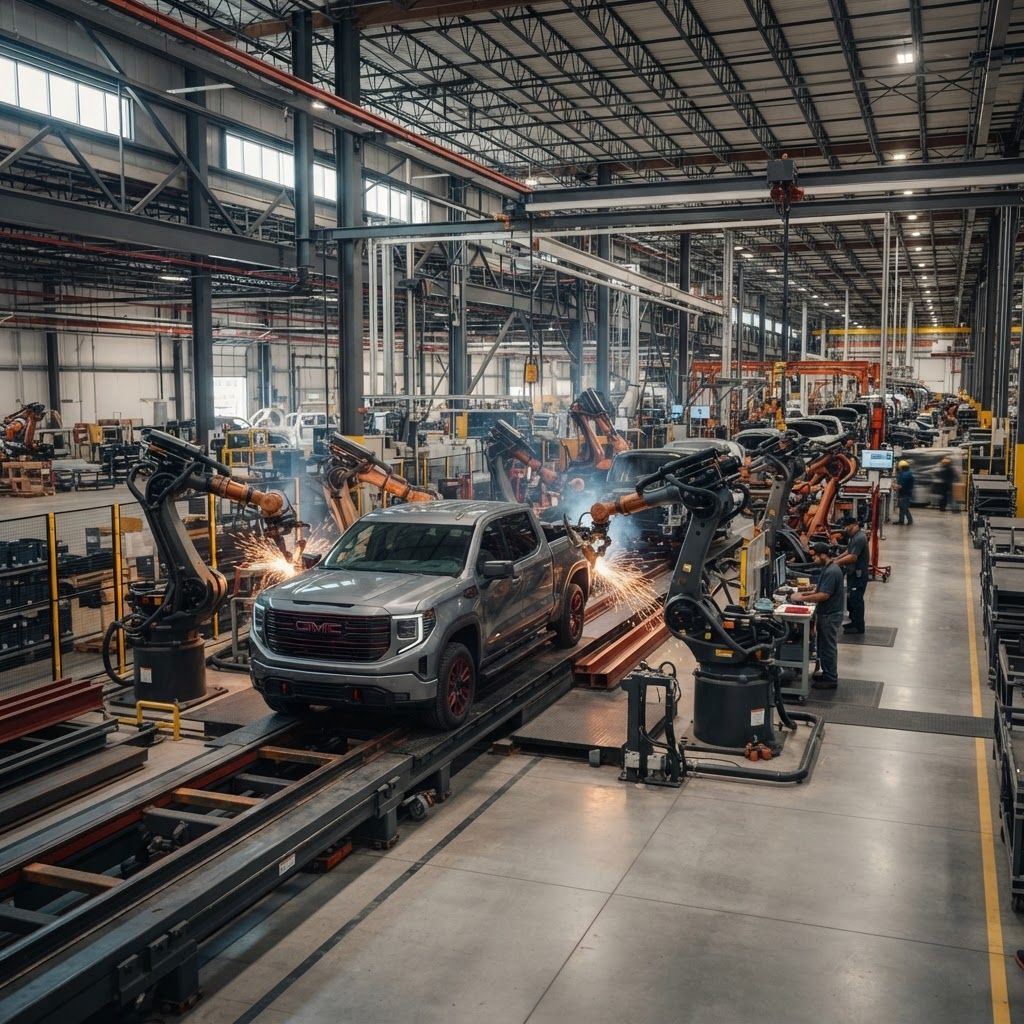
Inside San Antonio's automotive manufacturing cluster
Modern automotive production is one of San Antonio's most important industrial success stories. Toyota's South Side assembly plant anchors a dense supplier network, while logistics providers, workforce programs, and regional manufacturers support just-in-time production. The cluster produces trucks and related components while creating opportunities in stamping, interiors, seating, axles, plastics, logistics, automation, and quality engineering.
This list includes vehicle manufacturers and major suppliers with meaningful connections to the local production system. They perform different roles, so the right partner depends on the component, process, certification, and volume required. Automotive sourcing rewards stable quality, rapid problem solving, cost discipline, and the ability to deliver in sequence without interrupting the assembly line.
1. Toyota Motor Manufacturing Texas
Toyota Motor Manufacturing Texas operates the large San Antonio plant that assembles the Tundra and Sequoia. The facility is the center of the local automotive ecosystem and is known for the Toyota Production System, continuous improvement, standardized work, and supplier collaboration. Its scale supports thousands of direct and indirect jobs. The plant's flexibility, quality culture, and investment in advanced production make Toyota the defining automotive manufacturer in San Antonio.
2. Navistar
Navistar established an advanced manufacturing facility in San Antonio for commercial vehicles. The plant broadened the city's automotive base beyond passenger and light-truck production. Commercial vehicles require complex powertrain, electronics, safety, and durability integration, and the operation uses modern digital and manufacturing systems. Navistar's presence attracts additional suppliers and gives local workers access to another major global production network.
3. Avanzar Interior Technologies
Avanzar Interior Technologies operates within Toyota's supplier ecosystem and provides vehicle interior systems. Its proximity to the assembly plant supports synchronized delivery and close production coordination. Interior modules demand precise fit, appearance, ergonomics, and traceability. Avanzar demonstrates the value of supplier co-location: bulky, configuration-specific assemblies can move to the line efficiently while engineering and quality teams respond quickly.
4. Toyotetsu Texas
Toyotetsu Texas produces stamped and welded automotive body components for Toyota's San Antonio operation. Stamping requires large presses, accurate tooling, robust material handling, and disciplined inspection. Small dimensional variation can affect downstream welding and vehicle fit. The company's integration into the local cluster supports just-in-time flow and rapid communication around quality, maintenance, and production changes.
5. Topy America
Topy America is associated with wheel manufacturing and automotive components. Wheels combine safety-critical engineering, dimensional accuracy, surface quality, and fatigue performance. A supplier in this category must manage metal-forming processes, testing, coating, and delivery consistency. Topy's place in the Toyota supplier network illustrates how specialized component expertise supports large-scale vehicle assembly.
6. Aisin
Aisin is a major global automotive supplier whose broad portfolio includes drivetrain, body, chassis, and other vehicle systems. Its relationship to Toyota and footprint within North American manufacturing make it important to the San Antonio supply chain. Large integrated suppliers offer engineering depth and global lessons, but must still execute locally. Buyers value launch management, defect prevention, capacity planning, and continuous cost improvement.
7. Futaba Industrial Texas
Futaba supplies stamped, welded, and structural vehicle components within Toyota's manufacturing network. These parts must meet demanding requirements for geometry, weld integrity, corrosion protection, and crash performance. Localized production helps reduce logistics complexity for large assemblies. Futaba's role demonstrates that a vehicle plant depends on many highly coordinated manufacturers, each responsible for consistent quality at line speed.
8. Metalsa
Metalsa designs and manufactures structural components and chassis systems for light trucks and commercial vehicles. Its capabilities align well with San Antonio's concentration in trucks and utility vehicles. Structural suppliers combine forming, welding, automation, metrology, and engineering validation. Customers assess launch readiness, equipment redundancy, material traceability, and the ability to manage design changes without disrupting production.
9. International Automotive Components
International Automotive Components produces interior systems and components for global vehicle manufacturers. Interior work integrates molded parts, coverings, acoustics, fasteners, electronics interfaces, and appearance standards. Regional relevance comes from the need to support vehicle programs with responsive manufacturing and engineering. The best interior suppliers balance visual craftsmanship with automation, durability, weight, cost, and recyclability.
10. Reyes Automotive Group
Reyes Automotive Group is a San Antonio-rooted supplier associated with the local Toyota ecosystem. The company represents the growth of diverse, locally connected manufacturing enterprises alongside a global automaker. Its work in automotive components and supplier operations contributes to the cluster's depth. Local leadership, proximity, and understanding of customer systems can enable fast decisions and strong working relationships.
What distinguishes a strong automotive supplier
Automotive customers expect formal quality planning, capable processes, statistical control, traceability, and rapid containment when a problem appears. Suppliers should demonstrate relevant quality certification, preventive maintenance, error-proofing, layered audits, and disciplined launch processes. Financial stability and capacity matter because a missed shipment can stop an entire assembly line. Cybersecurity and software quality are also becoming more important as vehicles and factories become increasingly connected.
The next phase of San Antonio automotive growth will involve electrification, advanced driver systems, lighter materials, automation, and workforce development. Even combustion-powered trucks now contain sophisticated electronics and software. Local manufacturers that invest in flexible equipment, technical training, energy efficiency, and resilient sourcing can compete for future programs. San Antonio's greatest advantage is not one factory alone, but a collaborative production network built around quality and speed.
