
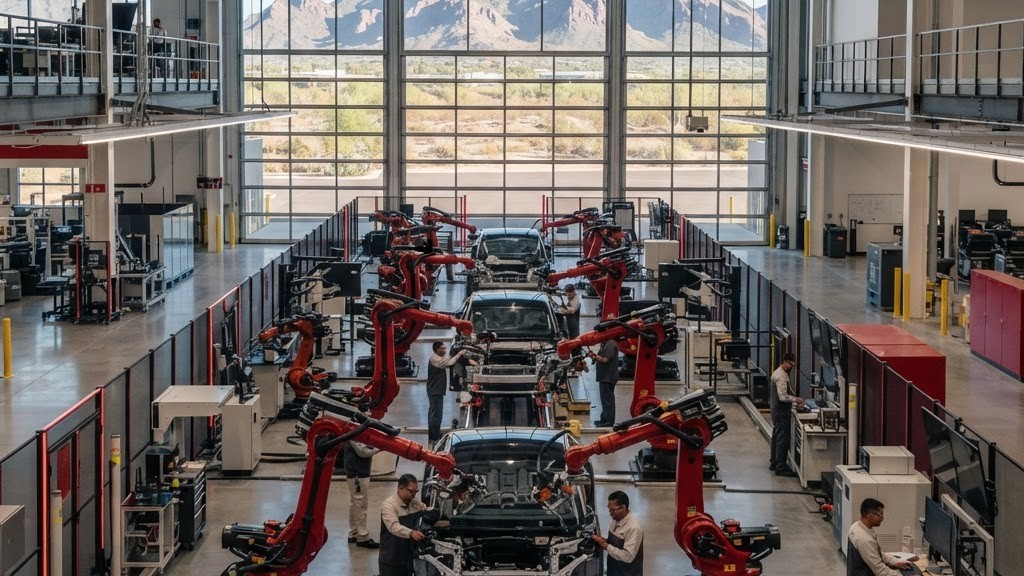
Understanding Phoenix's Automotive Industry
Phoenix is not a traditional high-volume auto assembly capital, yet Greater Phoenix and central Arizona have become an important mobility corridor. The region offers year-round testing weather, desert proving grounds, a growing engineering workforce, proximity to Mexico's automotive supply chain, and strong demand for trucks, fleet vehicles, and heat-ready electric transportation. The companies below range from vehicle manufacturers to critical suppliers and testing organizations. That diversity gives buyers and job seekers a more accurate picture of the local industry than a list limited to assembly plants.
1. Lucid Motors
Lucid Motors manufactures luxury electric vehicles in Casa Grande, within the broader central Arizona industrial region. Its advanced electric powertrains, long-range focus, aerodynamic design, and vertically integrated technology have made it one of the state's most visible automotive investments. The facility has also encouraged supplier growth between Phoenix and Tucson. Lucid is a strong example of Arizona's potential to compete in premium electric mobility and advanced manufacturing.
2. Nikola
Phoenix-area Nikola has focused on zero-emission heavy trucks and supporting energy systems. Commercial trucking presents different engineering challenges from passenger cars, including payload, route economics, refueling or charging infrastructure, durability, and fleet uptime. Nikola's presence has helped position Arizona in the conversation around battery-electric and hydrogen-powered freight. Fleet buyers should evaluate total operating cost, service coverage, infrastructure availability, and real-world duty-cycle performance.
3. U-Haul International
Phoenix-headquartered U-Haul is best known for moving equipment and rental services, but its scale also supports substantial vehicle engineering, fabrication, fleet maintenance, remanufacturing, and lifecycle management. Managing a vast fleet requires practical expertise in durability, repairability, parts availability, telematics, and asset utilization. U-Haul's local headquarters makes it an influential mobility employer and a significant source of demand for automotive products and services.
4. Local Motors Legacy and Arizona Mobility Innovation
Local Motors, formerly based in the Phoenix area, became known for low-volume, digitally designed vehicles and microfactory concepts. Although the company no longer operates as it once did, its legacy remains relevant to Arizona's mobility story. It demonstrated how co-creation, additive manufacturing, and smaller production cells could challenge conventional development. The talent and lessons associated with that experiment continue to influence regional innovation.
5. KORE Power and Battery Ecosystem
KORE Power's Arizona plans and regional battery activity connect Phoenix to the energy-storage supply chain that supports electric vehicles. Battery cells, modules, controls, and safety engineering are central to modern automotive manufacturing. Even when products serve grid storage as well as transportation, the manufacturing capabilities overlap. Buyers and partners should assess cell chemistry, thermal management, cycle life, quality systems, domestic sourcing, and end-of-life strategy.
6. Magna
Magna is one of the world's largest mobility technology and automotive supply companies, with capabilities spanning body systems, powertrain, electronics, seating, and complete vehicle engineering. Its activity in Arizona's broader automotive ecosystem reflects the role of global Tier 1 suppliers in supporting new vehicle programs. Such partners can help manufacturers industrialize designs, validate components, and meet demanding cost and quality targets.
7. ZF
ZF supplies driveline, chassis, braking, steering, and vehicle-control technologies used across passenger and commercial vehicles. Its relevance to the Phoenix market includes support for fleets, manufacturers, and advanced mobility programs. As vehicles become software-defined and electrified, suppliers like ZF increasingly integrate mechanical systems with sensors and control software. Buyers should consider functional safety, serviceability, calibration support, and long-term parts availability.
8. Bridgestone Americas Proving Ground
Bridgestone operates a major proving ground near Phoenix where tires and vehicles can be tested under severe heat and demanding road conditions. Testing is a crucial form of automotive production support because desert temperatures expose weaknesses in rubber compounds, batteries, cooling systems, interiors, and electronics. The facility strengthens Arizona's reputation as a place where manufacturers validate durability before market release.
9. Nissan Technical Center Arizona
Nissan's Arizona testing operations use the state's climate and varied terrain to evaluate vehicle performance and durability. Proving-ground work can include hot-weather operation, braking, handling, emissions, cooling, noise, and long-term endurance. These capabilities contribute engineering jobs and make the region valuable even without a large Nissan assembly plant. For the industry, objective testing reduces warranty risk and improves customer confidence.
10. Bent River Machine and Specialty Automotive Suppliers
The Valley includes precision machine shops and specialty fabricators serving motorsports, off-road vehicles, restoration, aerospace, and commercial fleets. Collectively, these smaller manufacturers fill an important niche with prototypes, machined components, custom suspension parts, enclosures, and low-volume assemblies. Their flexibility can be an advantage when a project requires rapid iteration or quantities too small for a large Tier 1 supplier.
What Makes Arizona Attractive
Arizona offers a favorable logistics position connecting California, Texas, and Mexico. Industrial growth in Pinal County has created a manufacturing corridor accessible from Phoenix's workforce and airport. The climate supports testing throughout the year, although extreme heat also raises facility cooling and worker-safety costs. State universities and community colleges are expanding programs in engineering, batteries, automation, and skilled trades.
Automotive Trends to Watch
Electrification is the clearest trend, but it is not the only one. Fleets are adopting telematics, predictive maintenance, driver-assistance systems, and route optimization. Manufacturers are experimenting with additive tooling, digital twins, and more regional supply chains. Heat performance will remain a Phoenix specialty as electric batteries, sensors, and cabin systems face increasingly harsh conditions. Commercial and off-road applications are likely to remain particularly important because they fit Arizona's economy and geography.
Selecting a Manufacturing or Fleet Partner
Evaluate quality certification, engineering capability, production capacity, warranty support, and financial durability. For electric vehicles, study charging requirements, battery warranties, thermal behavior, and service coverage. For custom components, require drawings, material certifications, inspection records, and agreed tolerances. Phoenix's automotive landscape rewards practical collaboration: the strongest partner is not always the largest, but the one with proven capability in the exact vehicle class, environment, and production volume required.
