
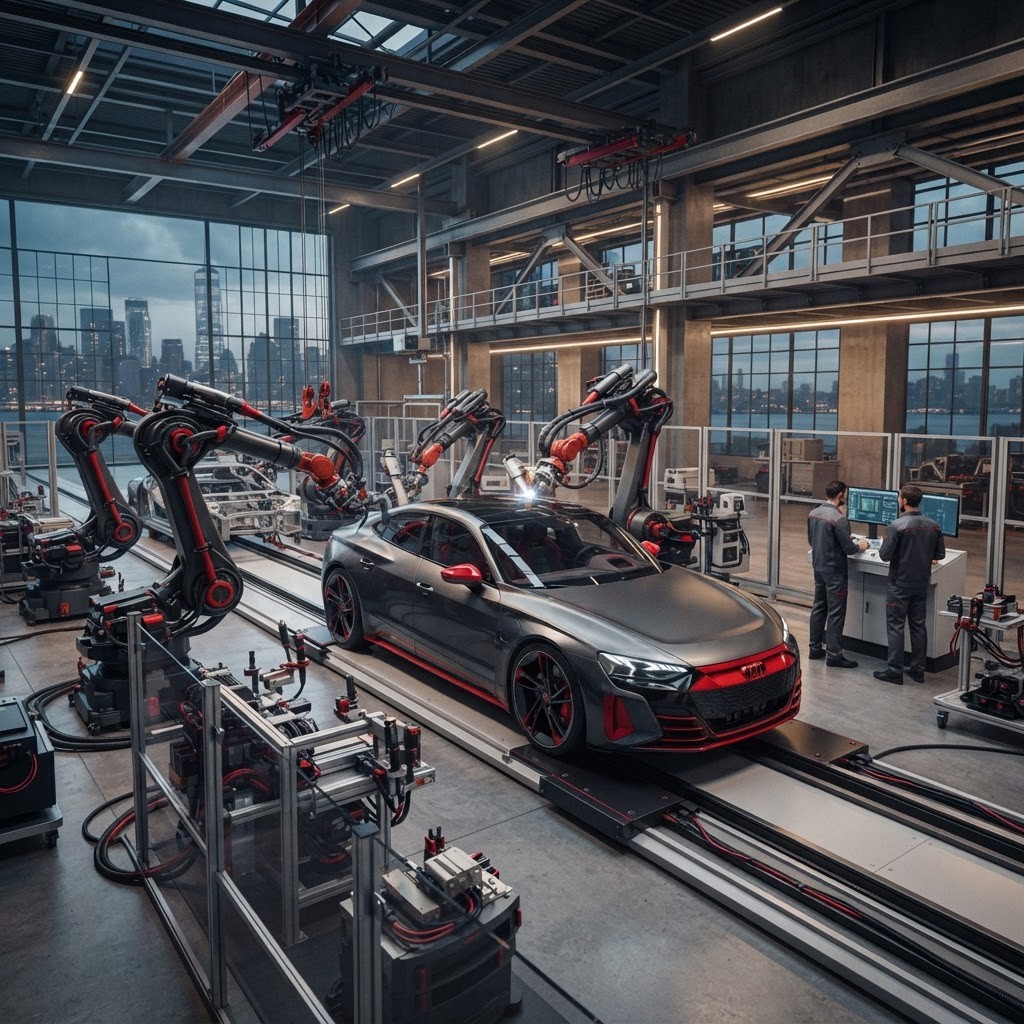
New York’s Automotive Manufacturing Landscape
New York is not defined by a single automotive corridor. Instead, its strengths are distributed among Western New York component plants, North Country assembly, Southern Tier transport technology, and metropolitan engineering talent. Manufacturers benefit from access to Northeast customers, research institutions, and a workforce experienced in precision production.
1. General Motors
General Motors’ Tonawanda operations are a cornerstone of Western New York manufacturing. The facility’s engine and propulsion expertise, large skilled workforce, and integration into a global production system create significant regional impact. Ongoing investment reflects the plant’s ability to adapt as vehicle technology changes.
2. Ford Motor Company
Ford’s Buffalo-area stamping operations supply formed metal components for vehicle assembly. Large-scale stamping requires tooling precision, process stability, logistics coordination, and strong safety systems. The plant demonstrates New York’s importance within national automotive supply chains even when final assembly occurs elsewhere.
3. Stellantis
Stellantis maintains component manufacturing activity in the state through operations connected to its North American brands. Its facilities and suppliers contribute powertrain and related expertise, while the global company’s transition toward electrification is influencing investment, skills, and sourcing decisions.
4. Tesla
Tesla’s Buffalo facility is primarily associated with energy products and charging-related technology rather than complete vehicle assembly, yet it remains relevant to the automotive ecosystem. Charging infrastructure and power electronics are essential parts of electric mobility, and the site connects vehicle growth with distributed energy.
5. Nova Bus
Nova Bus manufactures transit buses in Plattsburgh and supports public transportation agencies across North America. The company’s strengths include heavy-vehicle assembly, low- and zero-emission platforms, and understanding of fleet operating needs. Local production also supports agencies seeking resilient domestic supply.
6. Prevost
Prevost’s Plattsburgh activity complements the region’s bus-manufacturing cluster. Known for premium motorcoaches and conversion shells, the company emphasizes durable construction, passenger comfort, engineering quality, and lifecycle support for demanding commercial operators.
7. Cummins
Cummins’ Jamestown Engine Plant is a major Southern Tier manufacturer of heavy-duty engines. Its technical workforce, advanced machining, testing, and long production history distinguish it. The facility is also part of the wider shift toward lower-emission power systems.
8. BorgWarner
BorgWarner has a substantial presence in Ithaca and develops propulsion and drivetrain technologies. Its portfolio spans conventional efficiency improvements and electrified-vehicle components. Engineering depth and relationships with global automakers make it a key innovation-oriented supplier.
9. Durez Corporation
Durez, with New York roots and operations, supplies high-performance thermoset materials used in demanding automotive components. Heat resistance, dimensional stability, and application engineering make specialized material producers vital partners for safer and lighter vehicles.
10. Imperium3 New York
Imperium3 New York represents the state’s emerging battery-manufacturing ambitions in the Southern Tier. Battery cells and associated technologies are central to electric vehicles and grid storage. The venture highlights both the opportunity and execution challenges involved in scaling new domestic manufacturing.
How to Assess an Automotive Manufacturer
Consider quality certifications, launch history, production capacity, automation, traceability, delivery performance, tooling ownership, warranty handling, and financial stability. Electric-vehicle programs also require expertise in battery safety, software, thermal management, and high-voltage testing.
Future of the Sector
Electrification, connected vehicles, lightweight materials, and public-transit investment are reshaping New York’s automotive base. Established plants that retrain workers and emerging firms that scale responsibly can both succeed. The strongest companies will pair innovation with the disciplined quality and supply reliability that transportation customers demand.
