
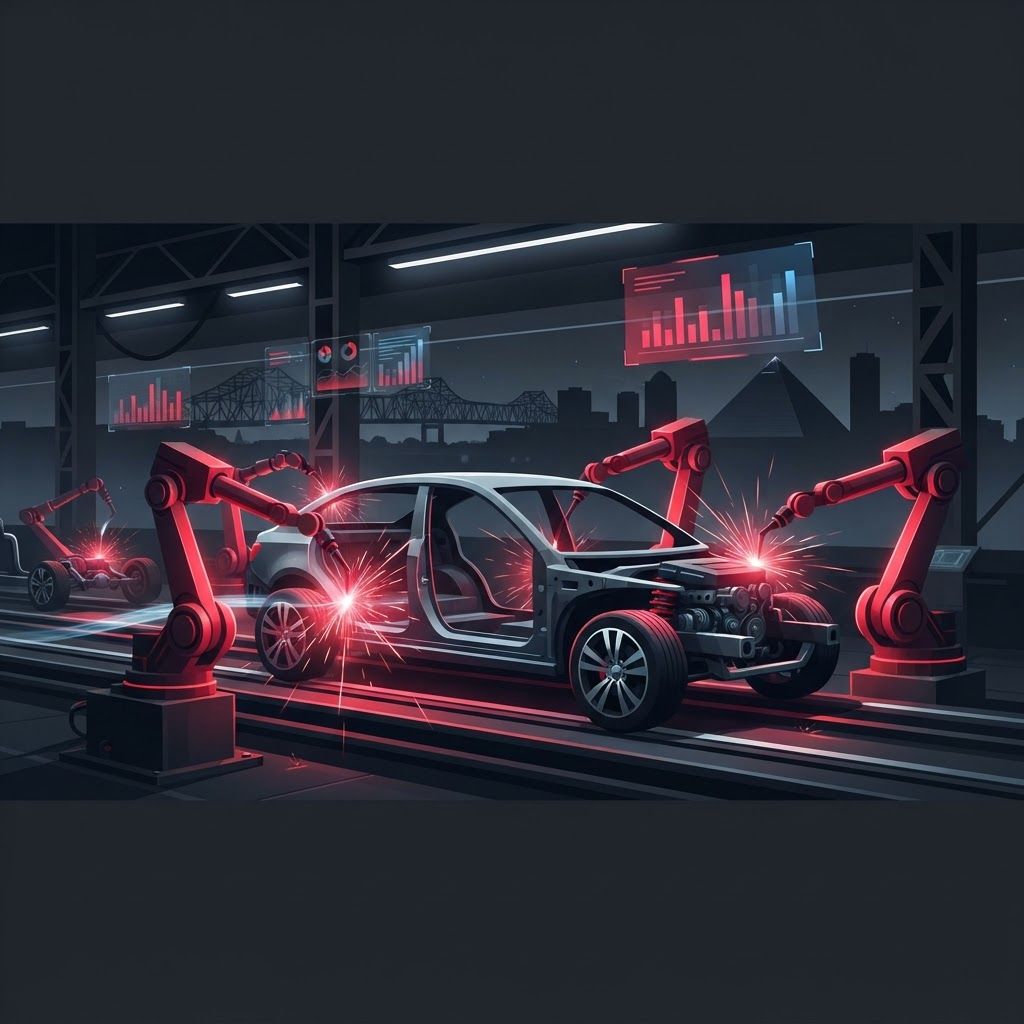
Memphis and the New Southern Auto Corridor
The American automotive map has shifted decisively toward the South, and Memphis now sits near the center of the most consequential build-out in decades. Just west of the city, massive electric vehicle assembly and battery manufacturing investments in West Tennessee have transformed a largely agricultural landscape into an advanced manufacturing campus. Memphis provides the metropolitan infrastructure supporting that growth: rail and highway connectivity, an enormous logistics workforce, warehousing capacity, engineering services and the supplier parks that feed just-in-sequence deliveries.
What makes the region distinctive is the combination of new-economy vehicle production with a long-standing base of components, metals, fluid systems and aftermarket distribution. A single Memphis industrial park may contain a stamping supplier, a plastics molder, a logistics provider running sequencing operations and a distributor shipping service parts nationwide. That density shortens supply chains and lowers inbound freight exposure at a time when both are strategic concerns.
How These Companies Were Evaluated
We looked at manufacturing footprint in the greater Memphis and West Tennessee area, technical capability, investment commitment, quality certifications common to automotive supply such as IATF standards, workforce development involvement and reputation among original equipment customers.
1. Ford BlueOval City
Ford's BlueOval City campus in West Tennessee is the anchor of the regional automotive economy. Designed as a vertically integrated site for next-generation electric truck production, it represents one of the largest single manufacturing investments in the state's history. The project is notable for its scale, its emphasis on sustainable operations including waste and water reduction goals, and its intent to co-locate suppliers on or adjacent to the campus. For Memphis, it means sustained demand for logistics, components, maintenance services and skilled trades.
2. BlueOval SK Battery Park
The battery manufacturing joint venture adjacent to the vehicle campus produces lithium-ion cells for electric vehicles at very large scale. Battery production is among the most technically demanding forms of manufacturing, requiring dry room environments, extreme contamination control, precise coating and calendering processes and sophisticated formation and testing. Its presence pulls specialized suppliers, equipment integrators and materials handlers into the region, raising the overall technical ceiling of West Tennessee manufacturing.
3. Nucor Steel Memphis
Nucor's Memphis operations produce special bar quality steel that feeds automotive forging, machining and component manufacturing. Electric arc furnace steelmaking gives the mill a lower carbon intensity than blast furnace routes, which matters increasingly to automakers reporting supply chain emissions. The mill is respected for metallurgical consistency, cleanliness requirements for critical safety parts and dependable regional delivery.
4. Mueller Industries
Memphis-headquartered Mueller Industries supplies copper and alloy tube, fittings and engineered components used in vehicle thermal management, brake and fluid systems, and increasingly in electric vehicle cooling architecture. Vertical integration from melting through fabrication allows tight control of tolerances and alloy properties. For engineers designing heat exchangers or fluid circuits, its application support is a practical advantage.
5. Tier One Interior and Seating Suppliers
The supplier parks surrounding regional assembly plants host interior systems manufacturers producing seats, door panels, headliners and consoles. These operations run sequenced production, building to a broadcast signal from the assembly line and delivering in build order within hours. Success requires disciplined material flow, error-proofing and near-perfect quality performance, since a single defect can halt an assembly plant. Their presence is a strong signal of regional manufacturing maturity.
6. Stamping and Metal Forming Manufacturers
Metal formers across the Memphis area supply brackets, reinforcements, structural components and weldments. Capabilities typically include progressive die stamping, robotic welding, laser cutting, tube bending and e-coating. The best suppliers invest in in-die sensing, automated vision inspection and simulation-driven die design, which reduces launch risk on new programs. They also serve agriculture, appliance and industrial customers, giving them useful diversification.
7. Plastics and Injection Molding Suppliers
Automotive plastics producers in the region mold clips, housings, ducts, trim and under-hood components, often with tight cosmetic and dimensional requirements. Many run scientific molding practices, cavity pressure monitoring and automated part handling to hold process capability across long production runs. Their proximity to assembly operations reduces freight cost on bulky, low-density parts, which is exactly where local sourcing pays off most.
8. Cummins Mid-South and Powertrain Service Operations
Heavy-duty powertrain sales, service and remanufacturing operations serve the enormous regional trucking fleet that keeps Memphis moving. Remanufacturing is a sophisticated form of manufacturing: cores are disassembled, cleaned, inspected, machined to specification and rebuilt to original performance standards. These operations support fleet uptime for logistics companies whose entire business model depends on scheduled reliability.
9. Commercial Truck Body and Trailer Manufacturers
Given the city's freight identity, truck equipment manufacturers and upfitters form an important local automotive segment. They fabricate and install dry van and refrigerated bodies, service bodies, liftgates, racking systems and telematics hardware. Their customers are fleet managers who value total cost of ownership, so the strongest builders emphasize corrosion protection, weight optimization and serviceability rather than lowest initial price.
10. Aftermarket Parts Manufacturers and Distributors
Memphis is a natural aftermarket distribution center, and several manufacturers and national distributors package, kit and ship replacement components from local facilities. Value-added services include kitting, private labeling, technical documentation and next-day delivery to independent repair shops across a wide radius. As vehicle parc ages and electric drivetrains introduce new service categories, this segment continues to expand.
Trends Reshaping Automotive Manufacturing in the Region
Electrification dominates every planning conversation. Battery, power electronics, thermal management and lightweight structures are absorbing engineering attention, while traditional engine content declines. Workforce development has become a competitive weapon, with community colleges, apprenticeship programs and employer-run academies racing to train technicians in mechatronics and battery process operations. Supply chain regionalization continues, with automakers pressing suppliers to locate closer to assembly sites. Finally, sustainability reporting requirements are pushing suppliers to document energy use, recycled content and emissions with far more rigor than in the past.
What Buyers Should Look For
Automotive sourcing decisions hinge on process capability rather than promises. Ask for capability indices on critical dimensions from actual production runs. Review launch history, including how the supplier handled its last problematic program. Confirm certification status and audit findings. Evaluate capacity honestly, including tooling redundancy and whether a single press or molding machine represents a single point of failure. For electric vehicle programs, verify cleanliness and contamination control practices, which are far stricter than legacy expectations.
Final Thoughts
Memphis and West Tennessee have moved from automotive periphery to strategic center in a remarkably short time. With flagship electric vehicle and battery investment anchoring the region and a broad base of metals, plastics, interiors and aftermarket capability supporting it, the local industry offers depth that few emerging clusters can match. Buyers who evaluate suppliers on demonstrated process control will find capable partners minutes from major freight corridors.
