
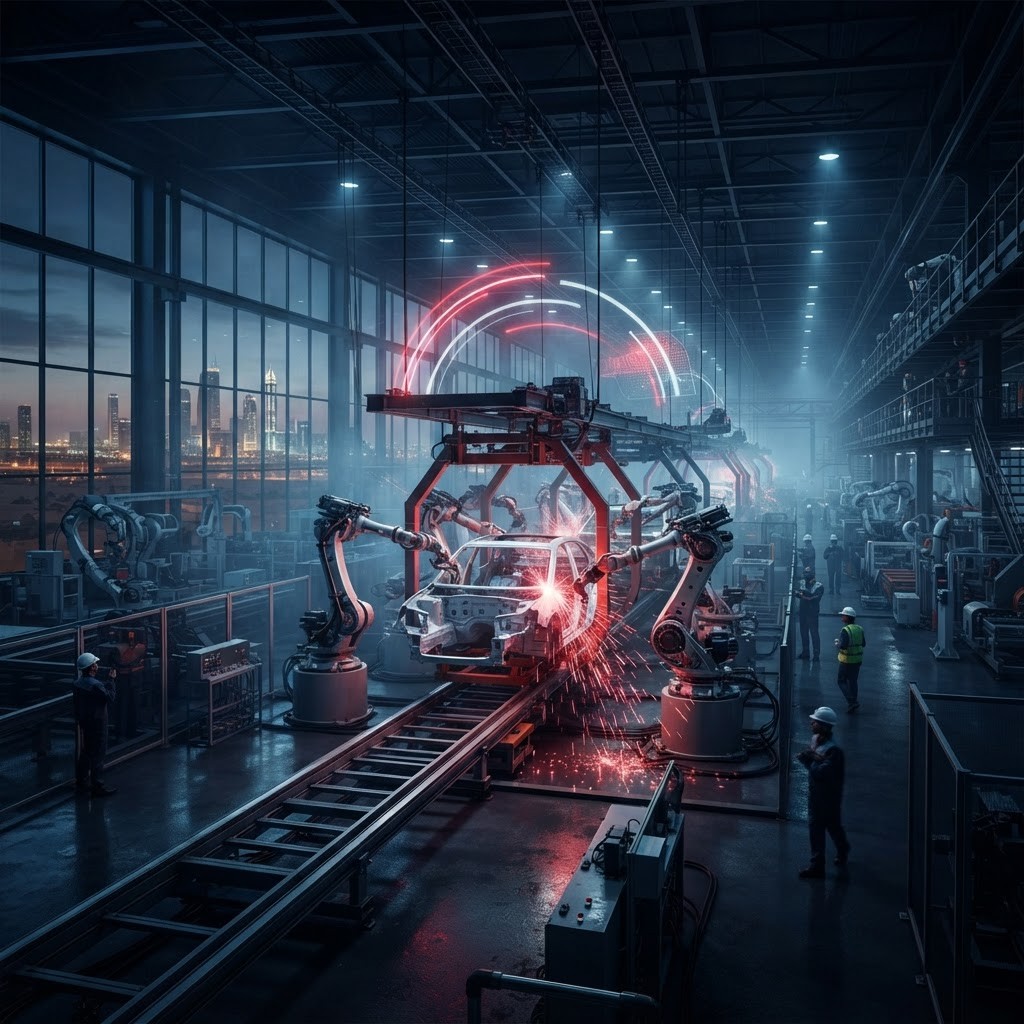
Where the Auto Industry Crosses the Border
Automotive manufacturing is a continental business, and El Paso sits at one of its most important junctions. Components produced in the borderplex flow northward to vehicle assembly plants across the American Midwest and South, while subassemblies and materials move southward into Mexican production. The Bridge of the Americas and nearby commercial crossings handle an extraordinary volume of automotive freight daily, and the just-in-time discipline of the industry means that customs efficiency here is measured in minutes.
What makes El Paso distinct is the combination of roles it plays. It is a warehousing and cross-dock hub, an engineering and program management center, a supplier base in its own right, and the administrative home for operations whose production floors sit across the river. Understanding the automotive landscape here means looking at that integrated system rather than at plant addresses alone.
The Ten Leading Automotive Manufacturers and Suppliers
1. Aptiv
Aptiv is among the most influential automotive suppliers in the borderplex, producing vehicle electrical architecture, wire harnesses, connectors and advanced safety electronics. Its differentiators include deep engineering collaboration with automakers, leadership in high-voltage architecture for electric vehicles, and the scale to support global platforms. Few companies have shaped regional automotive employment more.
2. Lear Corporation
Lear is a global leader in seating systems and electrical distribution, and its borderplex operations support both. Seating is labor-intensive, quality-sensitive and bulky, which makes proximity to assembly plants essential. Lear's reputation rests on ergonomic engineering, materials expertise and the ability to deliver sequenced sets exactly when a line needs them.
3. Yazaki North America
Yazaki is one of the world's largest producers of automotive wiring harnesses, and the borderplex is central to its North American footprint. Harness manufacturing requires enormous manual dexterity alongside rigorous electrical testing, and Yazaki's process discipline and connector technology make it a benchmark supplier for automakers across segments.
4. BorgWarner
BorgWarner supplies propulsion technologies, historically turbochargers, transmission components and thermal systems, and now increasingly electric drive modules, inverters and battery systems. Its regional relevance is growing precisely because electrification favors suppliers who can engineer power electronics and precision mechanical assemblies together.
5. Robert Bosch Operations
Bosch maintains substantial borderplex manufacturing supporting braking systems, sensors, electronic control units and driver assistance components. Its differentiators are research depth, functional safety expertise and a systems approach that spans hardware, software and calibration. For advanced driver assistance content, Bosch remains a first-tier reference.
6. Nemak
Nemak specializes in aluminum castings for powertrain and structural applications, including cylinder heads, blocks and increasingly electric vehicle battery housings and structural components. Lightweighting is one of the most durable trends in vehicle engineering, and high-integrity aluminum casting is central to it.
7. Johnson Controls and Adient Seating Operations
The seating and interiors business that grew out of Johnson Controls, now operating as Adient, has long been part of the regional supply base. Interiors combine textiles, foam, trim, metal structures and electronics, making these plants some of the most operationally complex in the industry and a major consumer of local supplier capacity.
8. Cummins Regional Operations
Cummins supports commercial vehicle powertrains, filtration and aftertreatment systems, with distribution and service capability serving the heavy truck traffic that pours through El Paso. Its strengths include durability engineering for extreme duty cycles and a service network that keeps freight moving.
9. Delphi Technologies Legacy Operations
The propulsion-focused operations descended from Delphi Technologies continue to contribute fuel systems, engine management components and electronics to the regional base. Long institutional experience with high-precision machining and calibration remains valuable even as powertrain architectures evolve.
10. Regional Contract Assemblers and Trailer Builders
Rounding out the list is the layer of smaller regional manufacturers building trailers, specialty vehicle bodies, upfit equipment and aftermarket components. These firms serve local fleets, agriculture, construction and border logistics operators, and they provide the flexible, short-run capability that large tier one suppliers do not offer.
Trends Reshaping Automotive Production in El Paso
Electrification is the defining force. Wire harnesses are becoming high-voltage systems, castings are becoming battery enclosures, and thermal management has grown from an afterthought to a core engineering discipline. Suppliers that can retool for these products are expanding, while those tied exclusively to internal combustion content face harder decisions.
Nearshoring is the second force. Automakers burned by long, fragile supply chains are deliberately shifting content closer to assembly, and the borderplex is a primary beneficiary. The third force is automation applied selectively. Rather than replacing labor wholesale, plants are automating inspection, material handling and repetitive fastening while retaining human skill where flexibility matters most.
How to Choose an Automotive Manufacturing Partner
Automotive procurement is unusually rigorous, and for good reason. Confirm quality management certification appropriate to the industry, and look closely at process capability data rather than accepting assurances. Review production part approval documentation practices and change control discipline, since unmanaged changes cause most field failures. Evaluate capacity honestly against your volume forecast, including tooling ownership and duplicate tooling for risk mitigation. Assess logistics capability, particularly customs brokerage and cross-border transit reliability. Finally, weigh engineering responsiveness, because in this industry problems are inevitable and the difference between suppliers shows up in how fast root cause is found.
Final Thoughts
El Paso's automotive sector is a study in integration, linking engineering talent, manufacturing scale and border logistics into a single system that keeps vehicles rolling off lines across the continent. The manufacturers profiled here represent both the established backbone of the industry and the newer capabilities electrification demands. For any company sourcing automotive content in North America, this region deserves a place at the top of the evaluation list.
