
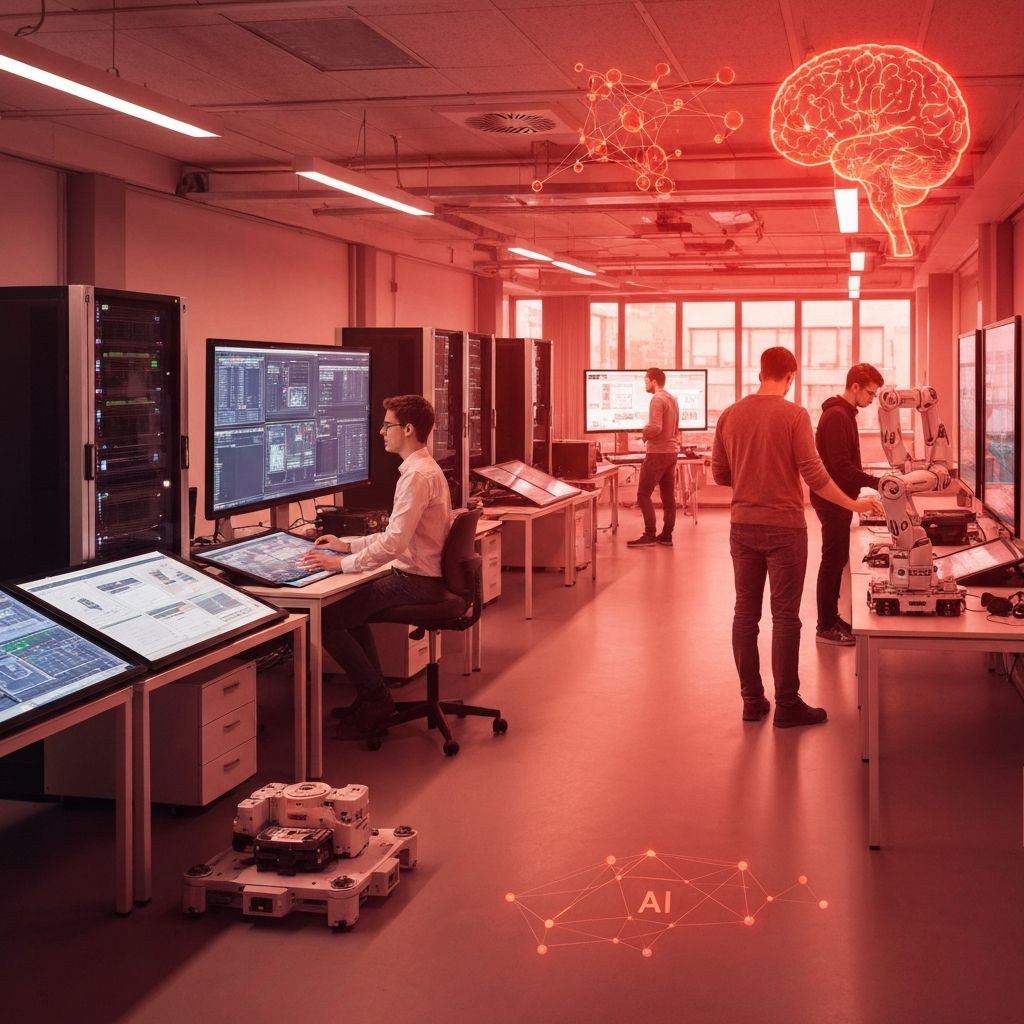
Germany's Rising Role in Global AI
Germany has emerged as one of Europe's most important hubs for artificial intelligence. With world-class research institutions, a strong industrial base, ambitious startups, and significant public investment, the country is shaping how AI is developed, deployed, and governed responsibly. From foundation models to industrial AI applications, German companies are making meaningful contributions to the global AI landscape.
The country's approach to AI is distinctive. It combines technological ambition with a strong emphasis on ethics, transparency, and human-centric design. This reflects both regulatory frameworks such as the EU AI Act and a broader cultural belief that AI should serve people and society, not the other way around.
What Sets German AI Companies Apart
German AI companies are known for their scientific rigor, often emerging from or partnering closely with leading research institutions such as the Max Planck Society, Fraunhofer Institutes, and top universities. This research-driven culture results in solutions that are technically robust and grounded in deep expertise.
Another defining trait is industrial focus. Many German AI firms specialize in applying AI to manufacturing, automotive, healthcare, energy, and logistics, leveraging the country's traditional strengths to deliver high-value enterprise applications. Trust, explainability, and compliance are central to how they design and deploy their solutions.
Top 10 Best Artificial Intelligence Companies in Germany
1. Aleph Alpha — A Heidelberg-based AI company developing sovereign large language models for European enterprises and public sector clients.
2. DeepL — Headquartered in Cologne, DeepL is a global leader in AI-powered translation and language technology.
3. Celonis — While primarily known for process mining, Celonis has become a major AI player by embedding machine learning into business process optimization.
4. Merantix — A Berlin-based AI venture studio building and scaling applied AI companies across healthcare, mobility, and industry.
5. Brighter AI — A Berlin company specializing in privacy-preserving computer vision technology, particularly relevant for automotive and smart cities.
6. Konux — A Munich-based industrial AI company focused on predictive maintenance and asset optimization for rail and infrastructure.
7. Parloa — A Berlin startup providing AI-powered conversational platforms for customer service, increasingly adopted by large enterprises.
8. Helsing — A Munich-based AI company focused on defense and security applications, demonstrating Germany's growing strategic AI capabilities.
9. Bosch Center for Artificial Intelligence — The AI arm of Bosch, advancing AI research and industrial applications across mobility, manufacturing, and consumer products.
10. Siemens AI — Siemens' broad AI initiatives span industrial automation, energy, and digital twins, making it one of the largest enterprise AI contributors in the country.
Key AI Application Areas
German AI companies are active across many sectors. Industrial AI, including predictive maintenance, quality control, and supply chain optimization, is a major strength. Healthcare AI is another important area, with applications ranging from medical imaging to clinical decision support and drug discovery.
Language AI, generative models, and conversational platforms are growing rapidly, with German companies investing in sovereign and multilingual solutions tailored to European needs. Automotive AI, particularly around autonomous driving and advanced driver assistance, remains a strategic priority given the country's automotive heritage.
Trends and Opportunities
Sovereign AI is a defining theme. European businesses and governments are seeking AI solutions that respect data sovereignty, regulatory compliance, and local values. German companies are well positioned to meet this demand with models and platforms developed and operated within the EU.
Responsible AI is another central focus. With the EU AI Act setting new global standards for transparency and risk management, German firms are investing in explainability, bias mitigation, and governance frameworks.
Industrial generative AI is emerging as a high-impact application. Beyond chatbots and content tools, German companies are using generative models to accelerate engineering design, optimize manufacturing, and enhance enterprise knowledge management.
How to Choose the Right AI Partner
When selecting an AI company in Germany, businesses should consider technical depth, domain expertise, data governance practices, integration capabilities, and ethical standards. The best partners combine cutting-edge technology with a thoughtful approach to deployment and impact.
Germany's leading AI companies are helping shape a future in which AI delivers real value while remaining aligned with human values. For organizations seeking to harness AI responsibly and effectively, the country offers an exceptional pool of partners and innovators.
