
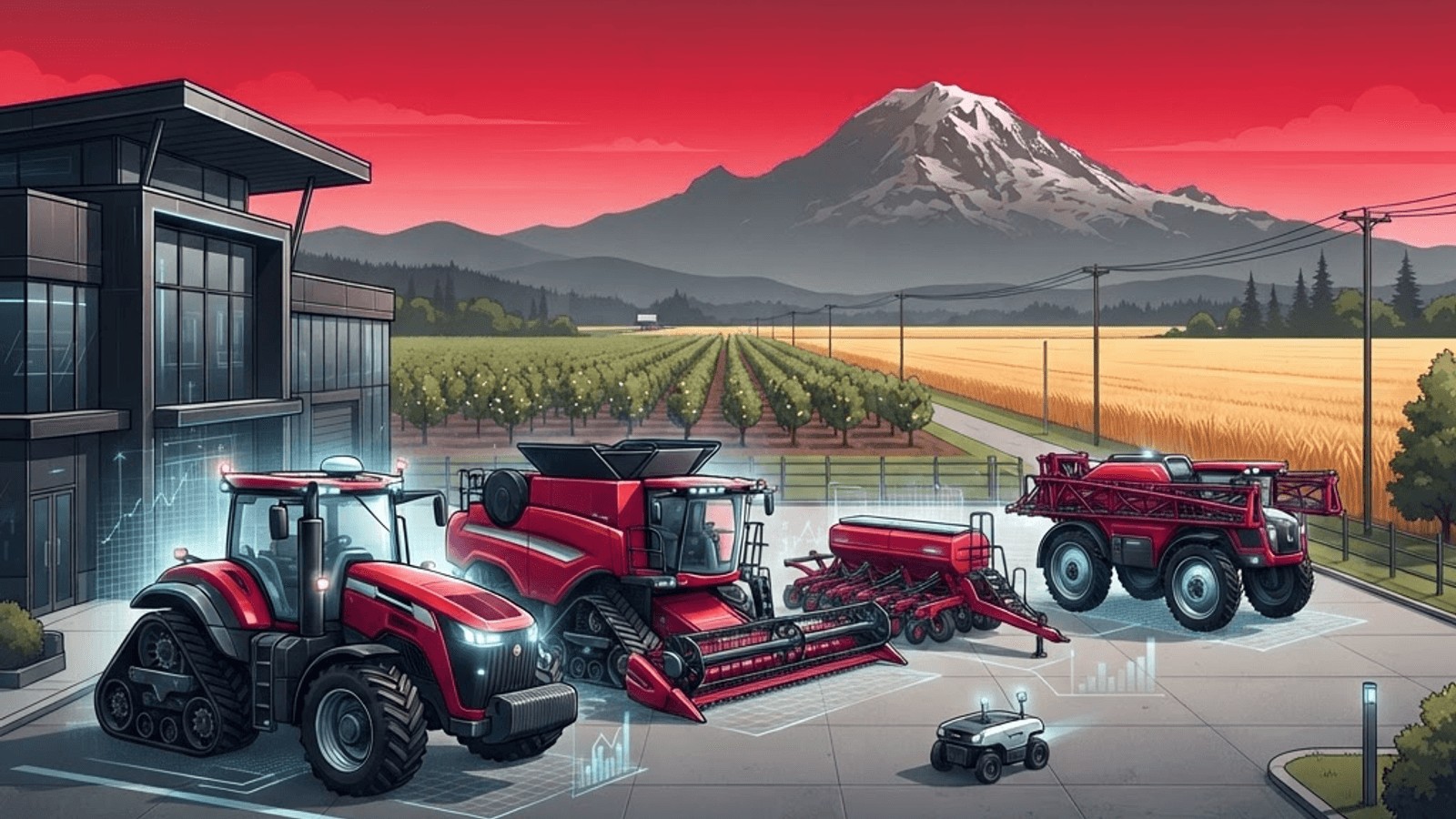
Machinery Requirements as Diverse as the Crops
No single equipment lineup suits Washington agriculture. A Wenatchee apple grower needs narrow, low-profile tractors that fit between high-density trellised rows, platform harvest aids and precision sprayers with drift control. A Palouse wheat farmer needs high-horsepower tractors, air seeders and combines capable of operating safely on steep slopes with leveling systems. A Columbia Basin potato operation needs heavy tillage, planters, windrowers and harvesters plus center pivot irrigation infrastructure. A Skagit Valley vegetable grower works in wet soils requiring different flotation and tillage strategies. Dairy operations need feed mixers, manure handling systems and forage harvesting equipment.
Consequently, brand reputation in Washington is inseparable from dealer capability. A tractor is only as good as the technician who can service it within a day during harvest, and the parts counter that has the right hydraulic fitting in stock at six in the morning.
How to Evaluate Equipment Brands and Dealers
Start with parts and service proximity. Ask how far the nearest stocking dealer is, how many field technicians serve your area and what the typical in-season response time is. Then examine technology openness: whether the machine's data can be exported to your chosen farm management platform, whether guidance systems work across brands, and increasingly whether you have the right to repair and diagnose the equipment yourself. Resale value should factor into total cost calculations, as strong secondary markets substantially lower effective ownership cost. Financing structures matched to seasonal cash flow, warranty scope on drivetrain and electronics, and availability of training for operators complete the picture.
Ten Notable Agricultural Equipment Brands and Suppliers in Washington
1. Cascade Orchard Machinery
A specialist in narrow-profile orchard and vineyard tractors, harvest platforms and canopy management equipment engineered for high-density plantings. Low center of gravity, tight turning radius and compatibility with trellis systems make its machines well suited to Washington tree fruit.
2. Palouse Harvest Systems
Focused on combines and headers configured for steep hillside operation, including self-leveling capability critical on the rolling terrain of southeastern Washington. Grain loss monitoring and yield mapping integration support agronomic decision-making across variable slopes.
3. Columbia Precision Irrigation
Supplying center pivots, drip and micro-irrigation systems, variable rate control panels and soil moisture sensing networks. Water efficiency engineering and retrofit programs help growers reduce consumption while maintaining yields, an increasingly urgent priority.
4. Rainier Tractor and Implement
A broad-line tractor and implement supplier covering compact utility through high-horsepower row crop machines, with tillage, loaders and hay equipment. Its strength is dealer depth: multiple service locations, mobile technicians and substantial parts inventory.
5. Northwest Sprayer Technologies
Producing air-blast and boom sprayers with drift reduction nozzles, targeted spray sensing and rate controllers. Reducing off-target application matters both for chemical cost and for regulatory compliance near residential and waterway boundaries.
6. Salish Dairy Equipment Systems
Supplying milking parlors, feed mixers, manure handling and slurry application equipment for western Washington dairies. Nutrient management compliance support and equipment reliability during twice-daily operation are central to its value.
7. Evergreen Farm Robotics
Developing and distributing autonomous and semi-autonomous equipment including robotic mowers, vision-guided thinning systems and driverless orchard platforms. Labor scarcity has moved these technologies from experimental to practical for progressive growers.
8. Olympic Hay and Forage Equipment
Specializing in mowers, conditioners, rakes and balers for alfalfa, timothy and grass hay production, including high-density export bale presses. Timothy hay export markets place a premium on bale consistency and moisture control.
9. Spokane Grain Handling and Storage
Providing augers, conveyors, grain dryers, aeration systems and bin construction for on-farm storage. The ability to store grain safely allows farmers to market strategically rather than selling at harvest-time prices.
10. Tacoma AgTech Guidance Solutions
Focused on GPS guidance, RTK correction networks, automated steering, variable rate application controllers and telematics retrofits for existing fleets. Because it upgrades machinery growers already own, it delivers precision benefits without full equipment replacement.
Trends in Agricultural Equipment
Automation is the dominant story. Labor shortages in specialty crops have accelerated adoption of robotic and autonomous systems for mowing, thinning, spraying and harvest assistance, and orchard platforms have already changed labor productivity substantially. Precision agriculture has matured from guidance into full variable rate management, with prescription maps driving seed, fertilizer and water application at sub-field resolution. Electrification is emerging in compact and orchard equipment where duty cycles suit battery capability and where emissions and noise near communities matter. Data interoperability has become a genuine purchasing criterion as growers resist being locked into single-vendor ecosystems, and right-to-repair expectations continue to grow. Finally, water technology investment is intensifying under drought pressure, with sensor-driven irrigation scheduling delivering measurable savings.
Practical Buying Advice
Match machinery to your actual field geometry and soil conditions rather than to horsepower marketing. Demo equipment in your own blocks during representative conditions, not on a dealer lot. Verify parts availability for the specific model, since newly introduced platforms sometimes lack local stock. Negotiate in-season service response commitments in writing. Consider retrofitting guidance and rate control onto existing machines as a lower-capital path to precision benefits. Evaluate used and off-lease equipment for secondary tasks. And factor operator training into the purchase, because advanced systems deliver their advantages only when used correctly.
Final Thoughts
Agricultural equipment decisions in Washington are ultimately decisions about uptime during narrow, unforgiving windows. Harvest does not wait, irrigation cannot pause in July heat, and spray timing is dictated by pest pressure rather than convenience. The brands and suppliers profiled here span orchard machinery, hillside harvest, irrigation, tractors, sprayers, dairy systems, robotics, forage, grain handling and precision retrofits. Judging them on dealer service capability, parts depth, data openness and demonstrated fit for your crop and terrain will produce far better outcomes than comparing specification sheets alone.
