
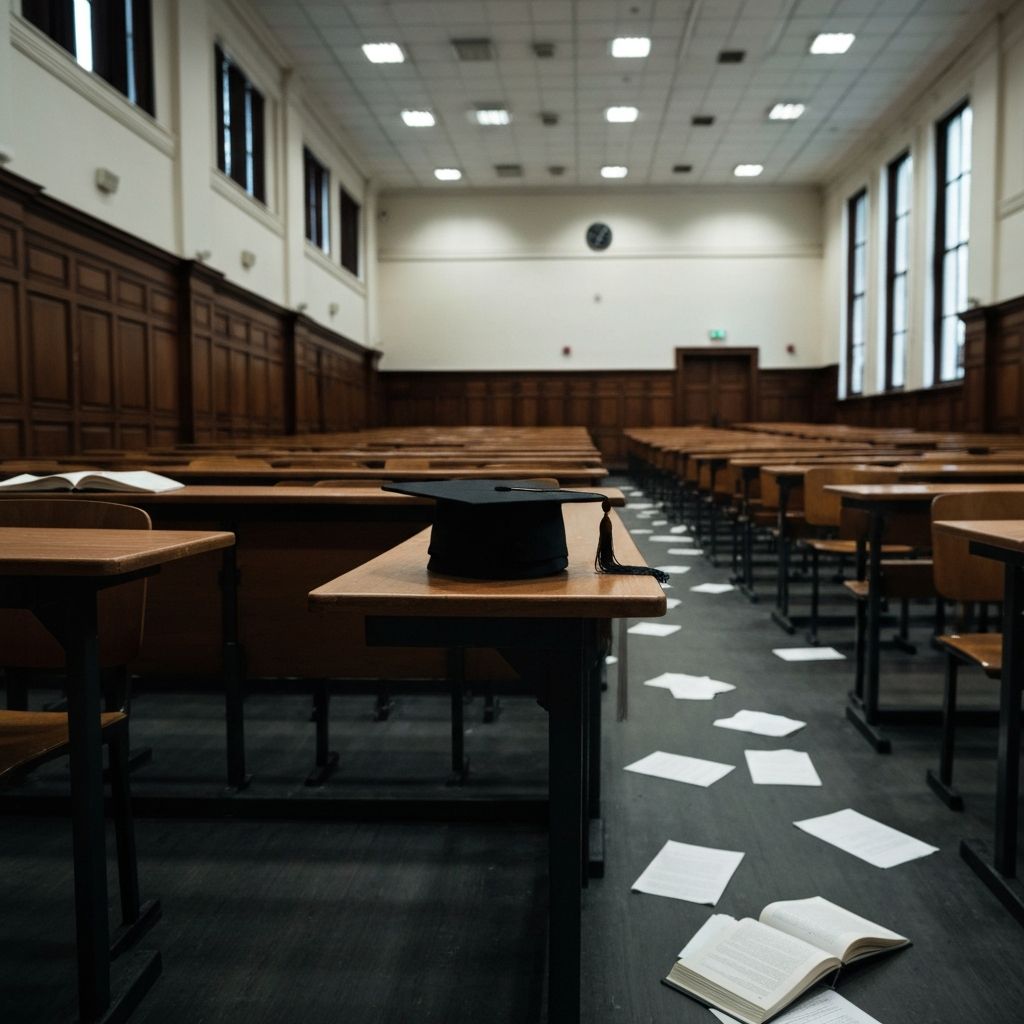
The State of Higher Education in Crisis
Higher education in the United States and across much of the developed world is experiencing a seismic shift — and not for the better. Enrollment numbers are declining at an alarming rate, student loan debt has surpassed $1.7 trillion, and a growing number of employers are dropping degree requirements from job postings. For decades, a college degree was considered the golden ticket to upward mobility. Today, that narrative is unraveling at a pace few predicted.
The statistics paint a stark picture. According to the National Student Clearinghouse Research Center, undergraduate enrollment in the U.S. has dropped by more than 15 percent over the past decade. Community colleges have been hit hardest, with some institutions seeing enrollment declines of 30 percent or more. Even prestigious four-year universities are feeling the pinch as students and families increasingly question whether the return on investment justifies the staggering cost.
Skyrocketing Tuition and the Debt Burden
The cost of a college education has risen at roughly three times the rate of inflation over the past 40 years. Average annual tuition at a four-year public university now exceeds $10,000 for in-state students and $23,000 for out-of-state students, while private institutions routinely charge $40,000 to $60,000 per year — and that is before room, board, books, and living expenses.
This relentless price escalation has saddled an entire generation with crippling debt. The average student loan borrower graduates with more than $30,000 in debt, and many carry far more. Monthly loan payments consume a significant portion of young graduates' incomes, delaying milestones like homeownership, marriage, starting a family, and saving for retirement. The psychological toll is equally devastating, with studies linking student loan debt to higher rates of anxiety, depression, and diminished life satisfaction.
Critics argue that universities have fueled this crisis through administrative bloat, extravagant campus construction projects, and a relentless pursuit of prestige rankings. While faculty salaries have remained relatively stagnant, the number of non-teaching administrative positions at American universities has grown by more than 60 percent since the 1990s. Students are effectively subsidizing bureaucracy rather than educational quality.
Declining Public Trust in Universities
Perhaps even more damaging than the financial crisis is the erosion of public trust in higher education institutions. Gallup polling shows that confidence in higher education has declined sharply over the past decade, with only about 36 percent of Americans expressing a great deal or quite a lot of confidence in colleges and universities — down from 57 percent in 2015.
This decline in trust spans the political spectrum, though it is more pronounced among certain demographics. Concerns about ideological bias in the classroom, a perceived disconnect between academic curricula and real-world job skills, and high-profile scandals involving admissions fraud and campus safety have all contributed to the growing skepticism. Many families now view a college degree not as a prerequisite for success but as an expensive gamble with uncertain returns.
The rise of alternative credentials — coding bootcamps, professional certifications, online learning platforms, and apprenticeship programs — has given prospective students viable pathways to well-paying careers without the time and financial commitment of a traditional four-year degree. Companies like Google, Apple, IBM, and Tesla have publicly stated that they no longer require degrees for many positions, signaling a fundamental shift in hiring practices.
The Impact on Institutions
Declining enrollment translates directly into financial distress for many colleges and universities. Tuition revenue is the lifeblood of most institutions, and when fewer students walk through the doors, budgets tighten. Smaller regional colleges and rural institutions are particularly vulnerable. Over the past five years, dozens of colleges across the country have closed their doors permanently, merged with larger institutions, or drastically cut programs and faculty positions.
Even larger universities are not immune. Hiring freezes, program eliminations, and deferred maintenance on aging campus infrastructure are becoming commonplace. Some institutions are attempting to diversify their revenue streams through online degree programs, corporate partnerships, and international student recruitment, but these strategies carry their own risks and are not guaranteed to offset declining domestic enrollment.
The demographic cliff — a projected sharp decline in the number of 18-year-olds in the U.S. beginning around 2025 — is expected to intensify the enrollment crisis further. Institutions that fail to adapt to this new reality face an existential threat.
What Students and Families Should Consider
For prospective students and their families, the current landscape demands careful, clear-eyed decision-making. A college degree still holds value in many fields — healthcare, engineering, law, and education, to name a few — but it is no longer a one-size-fits-all solution. Before committing to a four-year program and the associated debt, students should honestly assess their career goals, explore alternative pathways, and research the actual employment outcomes for graduates of their intended major and institution.
Community colleges, trade schools, and online learning platforms offer high-quality education at a fraction of the cost. Apprenticeship programs in skilled trades like plumbing, electrical work, and welding can lead to six-figure careers without any student loan debt. For students set on a traditional university experience, attending an in-state public university, maximizing scholarships and financial aid, and graduating in four years are critical strategies for minimizing debt.
The Future of Higher Education
Higher education is not going to disappear, but it is going to change — profoundly. Institutions that survive and thrive will be those that prioritize affordability, demonstrate clear career outcomes for graduates, embrace technology-driven learning models, and rebuild trust with the communities they serve. The ivory tower model of academia, insulated from market forces and public accountability, is no longer sustainable.
Innovation is already emerging from unlikely places. Some universities are experimenting with income-share agreements, where students pay nothing upfront and instead commit a percentage of their post-graduation income for a set period. Others are redesigning curricula around competency-based learning, allowing students to progress at their own pace and earn credentials more efficiently.
The institutions that listen to students, respond to the labor market, and deliver genuine value will earn their place in the future of education. Those that cling to outdated models, unchecked spending, and a sense of institutional entitlement will not. Higher education has indeed hit a new low — but within that low point lies an opportunity for reinvention that could ultimately serve students and society far better than the system it replaces.
