
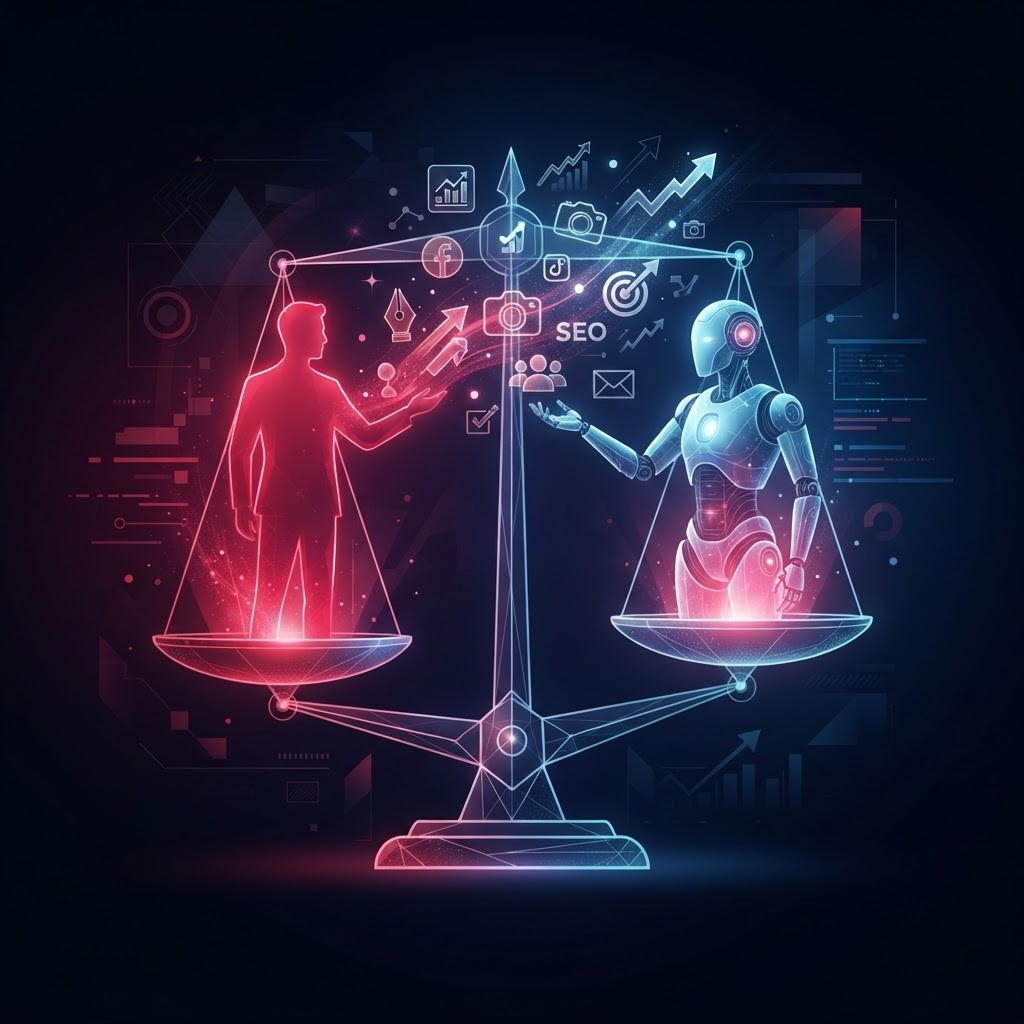
Few questions cause more anxiety in the marketing world today than whether marketing jobs are safe from AI. Automated tools now write copy, design graphics, analyze data, and manage ad campaigns, tasks that once required entire teams. It is natural to wonder whether human marketers are being edged out. The honest answer is that AI is reshaping marketing roles rather than eliminating the profession, and marketers who adapt will find themselves more valuable, not less.
What AI Is Actually Automating
AI has proven especially capable at high-volume, repetitive marketing tasks. Generating first drafts of content, resizing creative assets, sorting and analyzing customer data, scheduling posts, and optimizing bids on ad platforms are all areas where automation now handles much of the workload. For routine execution, AI is fast, tireless, and cost effective. Roles built entirely around these mechanical tasks are the most exposed to disruption, and marketers in such positions have the strongest incentive to evolve.
The Human Skills AI Cannot Replicate
Marketing is fundamentally about understanding people, and this is where humans retain a decisive edge. Strategic thinking, brand storytelling, emotional intelligence, cultural awareness, and creative vision are difficult for AI to genuinely replicate. Building relationships, negotiating partnerships, interpreting nuanced market signals, and making judgment calls under uncertainty all require human insight. As AI handles more execution, these strategic and creative capabilities become the core of a marketer's value.
How AAMAX.CO Helps Marketers and Businesses Adapt
Navigating this transition is easier with an experienced partner. AAMAX.CO is a full-service digital marketing company serving clients worldwide, and they demonstrate how AI and human talent can work together productively. Their digital marketing services pair automation with seasoned strategists, showing that the goal is not to replace people but to amplify what skilled marketers can achieve. For businesses, this means better results; for marketers, it models the kind of AI-augmented practice that defines successful modern careers.
Roles That Are Evolving, Not Disappearing
Rather than vanishing, many marketing roles are being redefined. Content creators are becoming editors and strategists who guide and refine AI output. Data analysts are shifting from manual reporting to interpreting insights and advising on decisions. Campaign managers are learning to orchestrate AI tools across channels. In each case, the value moves up the ladder from doing the task to directing, evaluating, and applying strategic judgment to it. This evolution favors those willing to learn.
Future-Proofing a Marketing Career
Marketers who want to stay indispensable should embrace AI as a tool rather than resist it. Learning to use AI platforms effectively, developing prompt and workflow skills, and understanding the strengths and limits of automation are increasingly essential. Equally important is deepening the uniquely human capabilities of strategy, creativity, and relationship building. Continuous learning, curiosity, and adaptability are the traits that keep a marketing career resilient in a changing environment.
The Bigger Picture for Marketing Teams
At the organizational level, AI is expanding what marketing teams can accomplish rather than shrinking them into obsolescence. Teams can now run more campaigns, personalize at greater scale, and experiment more freely. This often creates demand for new skills and new roles, from AI specialists to experience strategists. The overall volume of marketing work tends to grow as the cost of production falls, sustaining the need for talented people to guide it.
Conclusion
Marketing jobs are not being made obsolete by AI, but they are being transformed. Purely mechanical tasks are at risk, while strategic, creative, and relationship-driven work becomes more valuable than ever. Marketers who adapt by mastering AI tools and doubling down on human strengths will thrive. Partnering with forward-thinking organizations that blend technology and talent shows exactly how this balance can be struck, ensuring both careers and businesses flourish in the age of AI.
